April 29th 2025
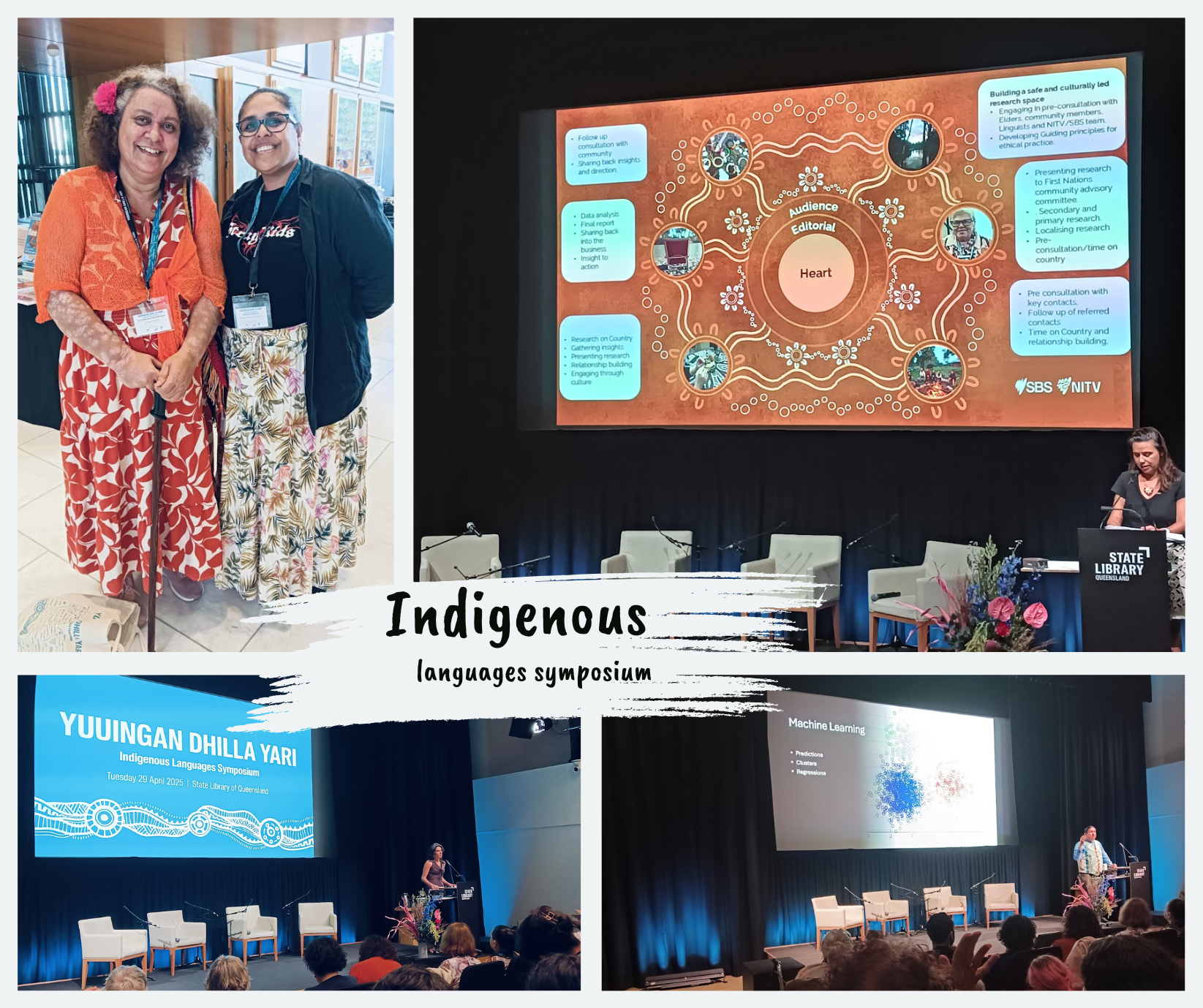
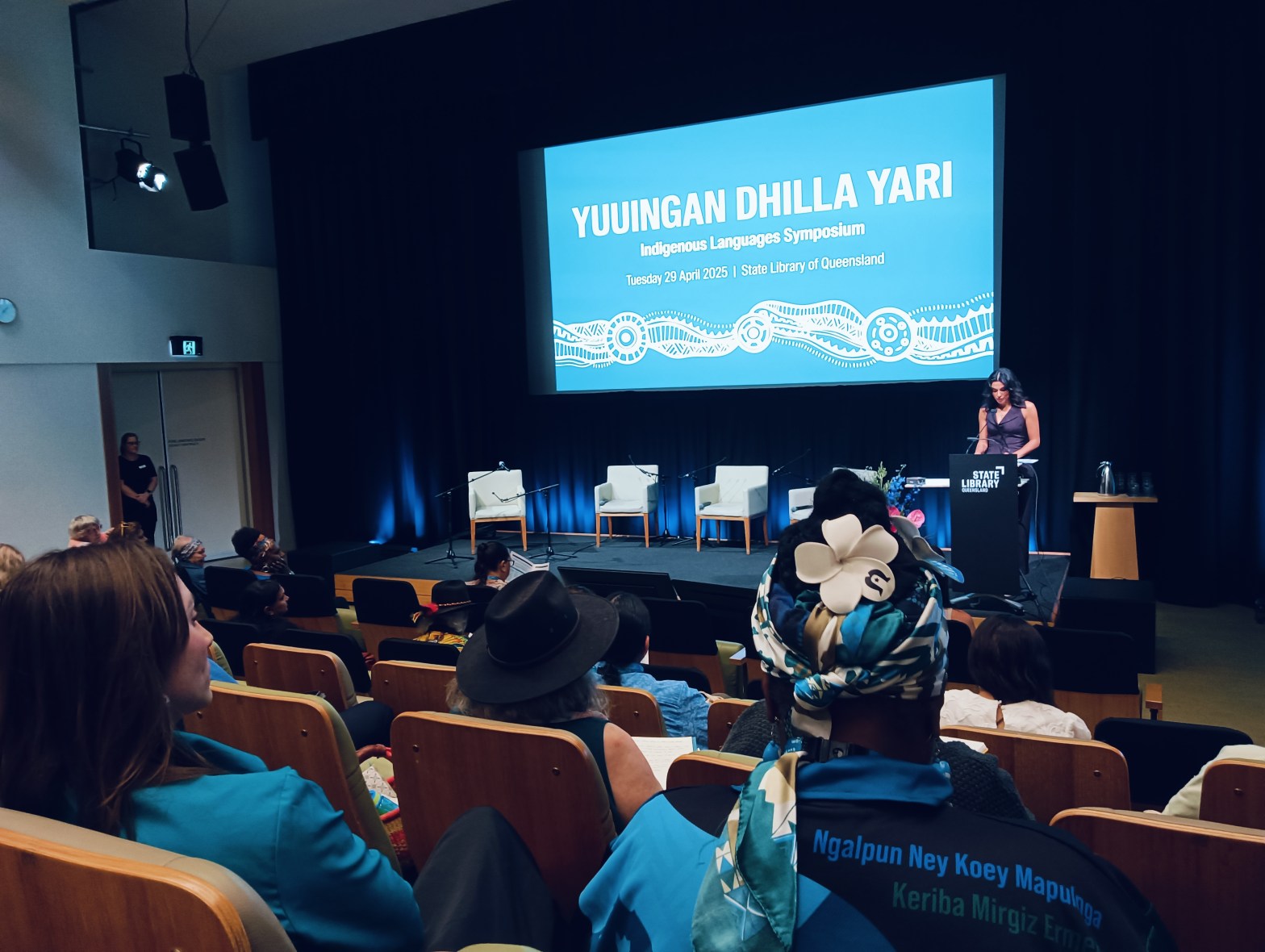
This was my third time attending Yuuingan Dhilla Yari, Indigenous Language Symposium at the State Library of Queensland. This symposium was the most interesting of all the programs so far. Perhaps because of the timely engagement with AI, popular culture and the history of Indigenous media and representation. For Full Program of the Symposium
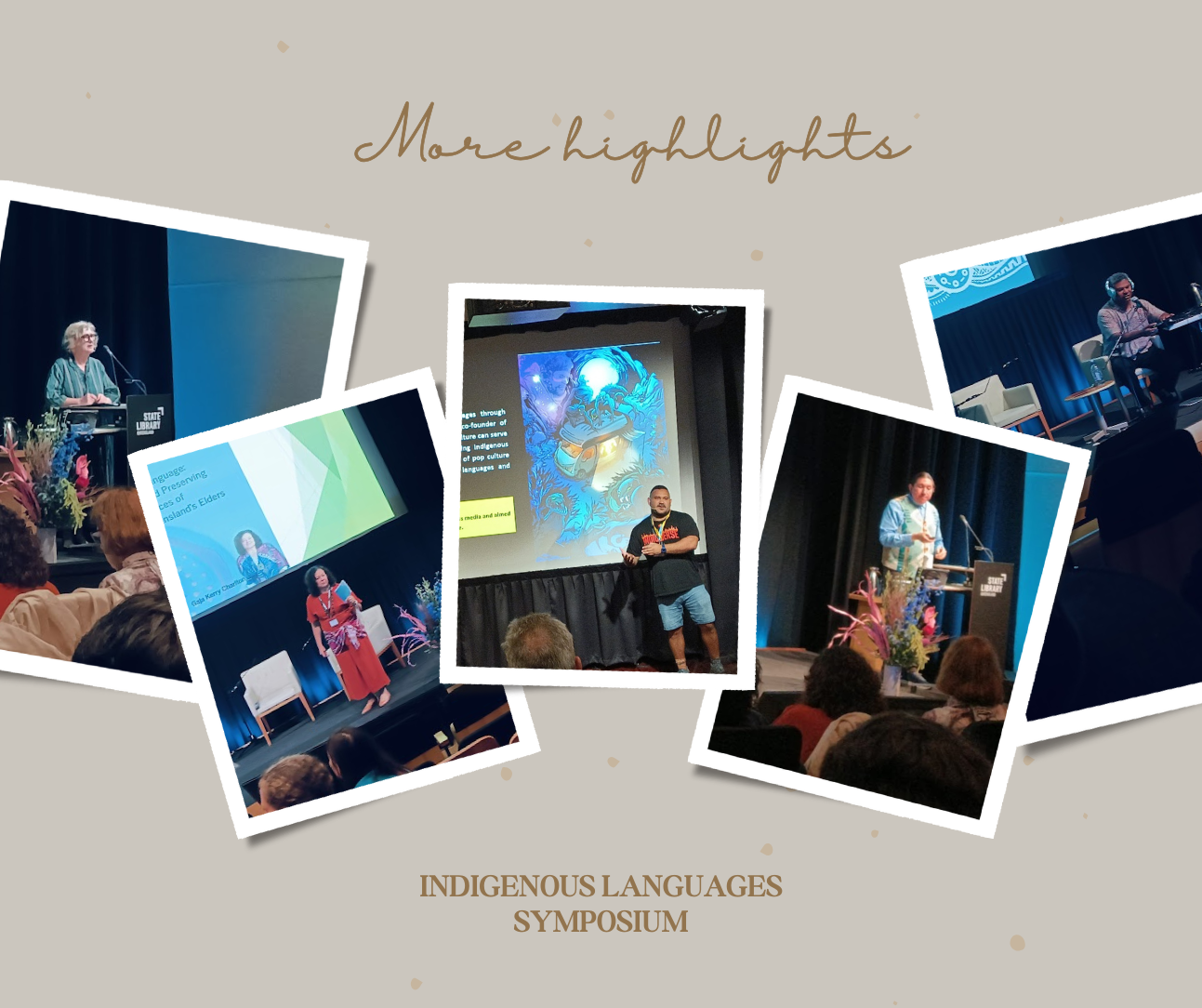
The day ran from 8 am to 5.30 with 4 concurrent sessions, 3 Keynotes, a wonderful panel, and a powerful closing performance from Fred Leone, a Butchella Songman with Tongan and South Sea Islander heritage. Some of the concurrent sessions were ‘In conversation’ and I attended one ‘in conversation with Megan Cope an inspiring artists working with language and maps. My favourite sessions were, both main keynotes, the panel, and the Put the PaP in Pop although all sessions were educational, with many nuggets of wisdom. In this post I will share my understanding of the first keynote speaker.
The first keynote was with Michael Running Wolf. Michael Running Wolf (Northern Cheyenne and Lakota) “revitalises Indigenous languages and cultures through Indigenous immersive technologies and AI, emphasising ethical practices that respect Indigenous knowledge. His work has earned the MIT Solve fellowship, Alfred P Sloan Fellowship and Patrick McGovern AI for Humanity Prize.”
Creating A First Languages Reality Using Regenerative AI Practices
Michael Running Wolf
The focus of his keynote was to address the risks and gains for First Nations, Indigenous language communities embracing advanced technology and balancing it with Indigenous ways of knowing.

Michael’s keynote did not shy away from utilising highly technical computer language, however he also provided connection for an audience where many might not have an extensive computer science background or a sense of its history. He asked us questions to draw us in, such as had any of us used excel, and had we then used it to generate a table.
I found myself writing down key terms to look up later, like algorithms, neural networks, machine language, AI, and was so engaged in the computer science history especially the story of Ada Lovelace, the daughter of Lord Byron the poet, that I looked up more of her story a week later, with great interest. The thing was the talk challenged me, and stretched my mind, and I wanted to understand more, as it was so highly engaging.
AI is something which is trained through data it is fed, and the more data there is the more accurate it can become. However, AI which tries to approximate neural networks, to become as human as it can, cannot do all the things that humans can when they communicate.
Michael argued that there are specific challenges for current Apps trying to teach First Nations language, one is how to ethically collect the data to generate grammar and vocab. If First Nations people with strong cultural values and respect for community are not part of the data collection and development teams, there is a real danger of colonisation occurring again, but this time through AI.
This is because language is at the heart of culture, strength and identity, and it is no accident that language is often removed as a systematic process of disempowerment, not just for colonisation but also in power struggles such as the English with the Irish.
Another challenge is that language apps and chat gpt are based around synthetic languages like English, Latin, German, Greek, which are synthetic languages. In polysynthetic languages lots of grammatical information is provided in a single word.
The take home messages of Michael’s presentation were that Indigenous young people of all classes need to be given opportunities to learn computer science, and become coders, but this is not enough they must also be strong in their culture. He feels that the tools of AI enable language restorative work to be more effective as practice and basic knowledge might be taken over by the apps, and Elders, give the more nuanced, deeper and spiritual understandings that provide the context for a language. However, it cannot and should not replace community but rather work in collaboration and be informed by community, but nor should it be ignored, rather it should be used. Something which was later taken up by Tanya Denning-Orman, Director of First Nations at SBS.
Michael shared with us work what is being done to involve fostering and discovering technological talent within First Nations communities. Using a Venn diagram, he looked at technology, community, talent, big data and the barriers to create positive interactions between these. The challenge for many First Nations communities, is that with language, there might be 500 speakers of Cheyenne compared to 100 million French speakers and half a billion English speakers. These might be tackled through initiatives which bridge the gap and create Indigenous ICT researchers, and specialists who have respect for Indigenous values. The FLAIR (First Language AI Reality) Initiative, is about building cultural respect and ownership of the data, to be collectively used and giving agency to First Nations young people to become the programmers.
He shared with us how much poverty there still is within communities that one of the best coders in one of the community workshops he ran said their favourite thing about the workshops was that they were well fed. However, he also used this anecdote to illustrate that there are many intelligent minds within reservations who might engage with creating AI apps that are culturally collaborative and relevant but who have just never had the opportunity or exposure. He gave the statistics of First Nations people doing research in the AI and computer science areas which was like O. 1. %
Michael cautioned First Nations people to be mindful where they shared linguistic knowledge, whether it be a blog, or chat gpt, as it could be harvested without context, and there is no real governance of this on a global scale. Whilst First Nations communities vary in how much they want to share knowledge of their languages, the main thing is that they should be able to be the custodians and keepers of this aspect and many other aspects of their culture, without having this taken from communities. Being able to have understanding and capacity to produce the apps but with a deep nuanced understanding is what will assist the interface between technology and culture ethical.
Michael compared the more secretive Cheyenne with the Lakota, who more liberally share, and that there are hobbyist language speakers with little knowledge of Lakota culture who have no connection to culture at a nuanced level. He also spoke of the Irish and their experience of having their language taken from them or supressed by the English.
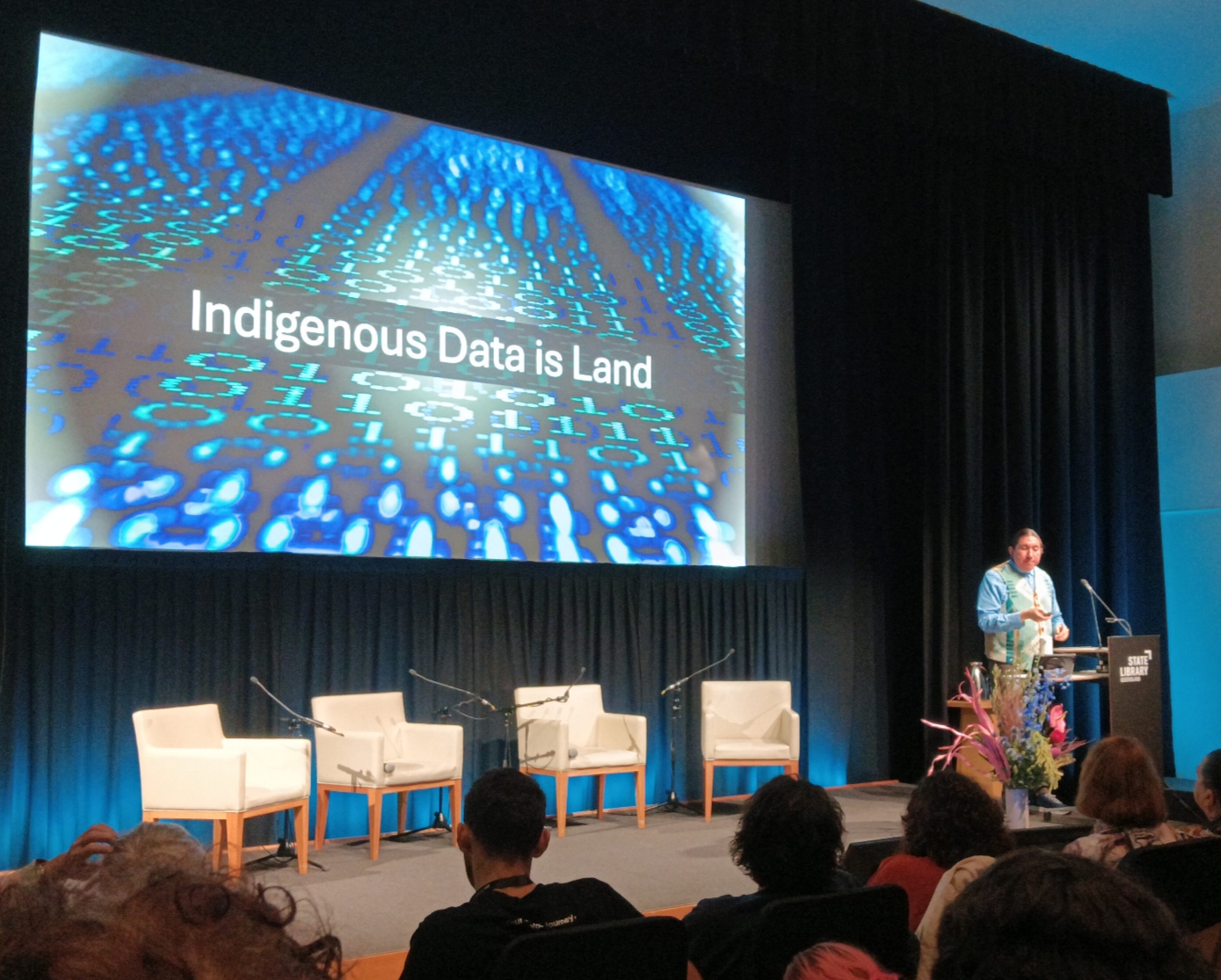
The FLAIR initiative of the MILA foundation, is about creating opportunity for young people in Indigenous community to realise their potential talent and pursue it. He encouraged all those in the audience to encourage and give opportunity that Indigenous people can become programmers, coders and more. He explained that data sovereignty is the goal, and AI is a possible tool if used wisely in that process. Such foundations are a beginning but in the future economies of scale, to have many such projects happening both nationally and globally and all linked up would be the ideal goal. ‘Indigenous Data is a Land’ is about Indigenous data sovereignty but ironically if you were to get AI to define this for you it would see this term only literally and say it is incorrect, how can data be a land. But if identify is shaped in contemporary technological spaces, social media, and more it is a space to be colonised and decolonise.
He shared how Te Hiku Media in New Zealand were an inspiration and mentor to FLAIR and encouraged something similar to be done in Australia, if it is not already, throughout communities here.
Going forwards he outlined the importance of not just documentation, but the development of curriculum, sustainability, access to legal infrastructures and policies for the protection of tribal data.
Throughout his talk, he demonstrated humour, respect for women and his wife, Caroline Running Wolf (also on the program) who is also a researcher and knows a lot about language and was approachable between sessions for questions or to chat to.
Exploration Links
 June Paisa Perkins