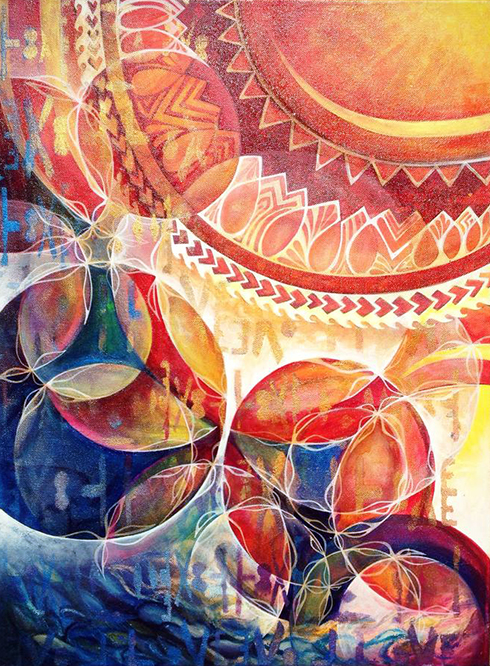
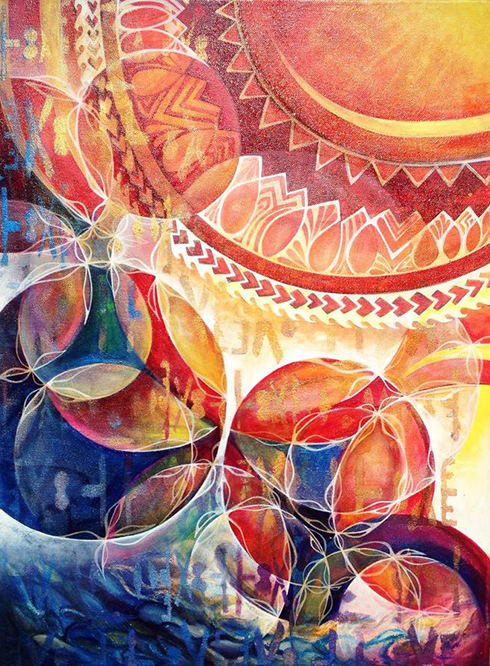
Minaira Fifita is a visual and performing artist whose artwork is grounded in her Polynesian and Celtic roots and nurtured by her faith in the unity. She grew up in the island nation of Tonga. The Baha’i faith and her family are very important to her and all of her siblings are artists.
Minaira has won various art competitions, including one for the Auckland Philharmonic Orchestra. She has found galleries to exhibit her work in both Australia and Tonga and continues to receive commissions.
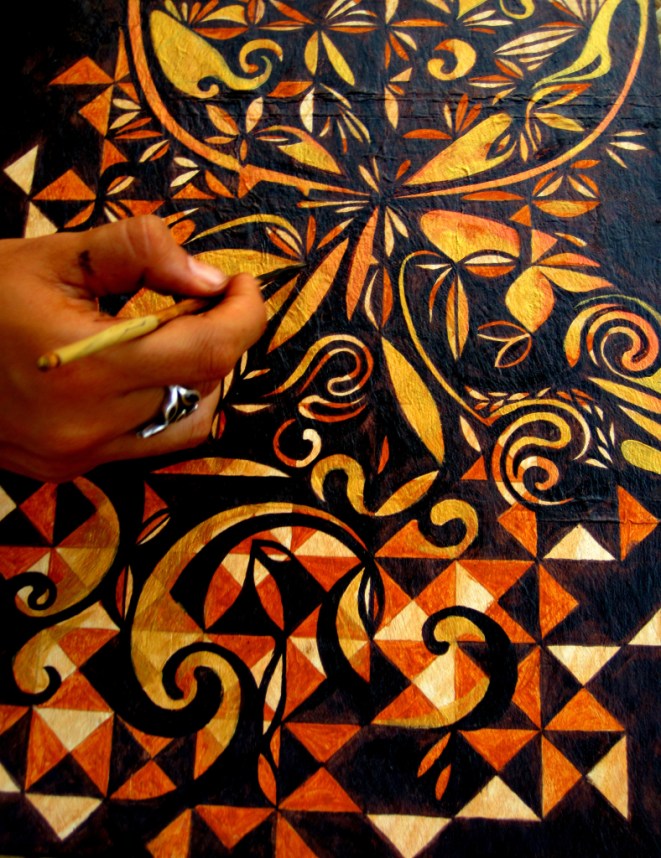
After graduating, the World Bank commissioned her to illustrate some stories for a teaching programme in Tonga. With the money from this work she was able to make payments towards her student fees. She also had the opportunity to work with well-known New Zealand artist Robin White, assisting on a collaborative tapa work with her sister, Ruha Fifita.
Ruha Fifita was born in Vava’u, Tonga, in 1990 and has spent most of her life with her family in Vava’u, Ha’apai, and Tongatapu. In 2006 she co-founded ON THE SPOT (OTS), an arts organisation aimed at exploring and utilising the arts as a tool for community building. She sees Tongan culture as a living entity and hopes her artwork inspires young people to take ownership of it. Ruha has a degree in Creative Industries from the Queensland University of Technology, Brisbane. She is currently Pacific Arts Research Assistant for the GOMA and is extensively involved in community building in the Goodna and scenic rim area.
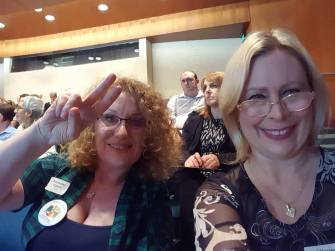
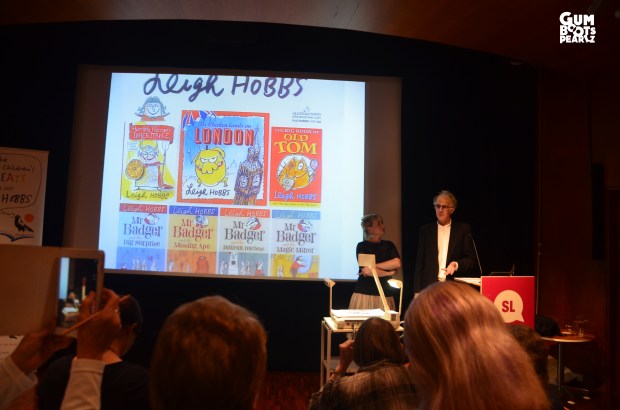
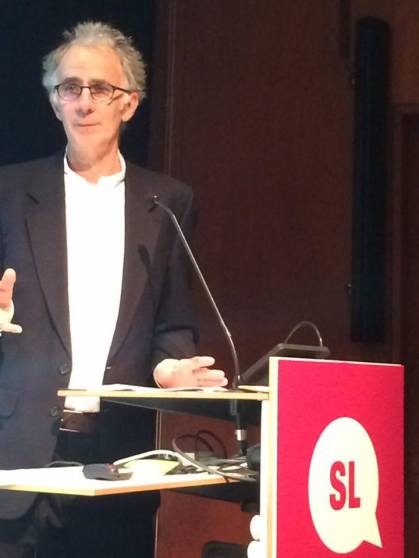
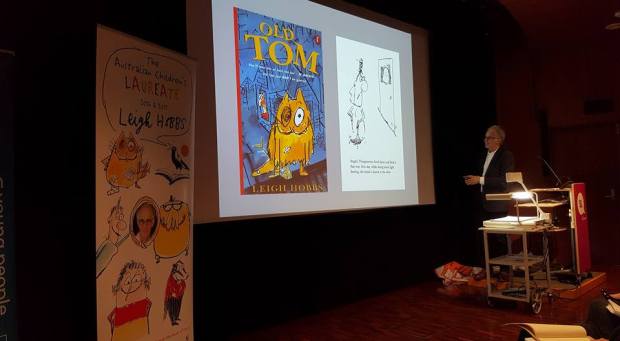
Leigh Hobbs, this year’s Australian Children’s Laureate, is about to give a lecture, The Mystery of Visual Literacy, to the three quarters full auditorium in the state library, Queensland. The talk has been sponsored by Book Links and the Queensland Writer’s Centre. Scanning the audience I see many of my Writelinks buddies, visitors from the Gold Coast and further afield, prominent children’s literature advocates, and several librarians.
Images Courtesy: Sam Sochacka , June Perkins (aka Gumbootspearlz), Jillanne Harrison, Giuseppi Poli, Leigh Hobbs & Sally (surname unknown)
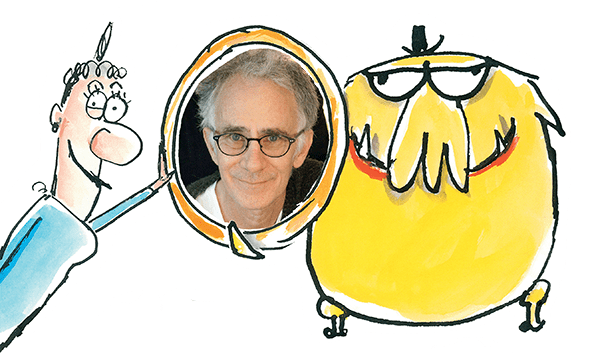
Mr Hobbs is the creator of Old Tom as well as Mr Chicken and the 4F For Freaks. I used to giggle watching the television version of Old Tom when my children were growing up, as it seemed to have a lot of jokes highly suitable for parents, not just their offspring.
He seems to have a spring in his step and twinkle in his eye before he even begins and smiles as he offers to sign posters, featuring some of his characters, that he has bought with him. Many of us line up and take him up on this offer.
Then Megan Daley, who doesn’t want to say anything about herself but is a great advocate for children’s literature, gives him a warm introduction, and talks about the good old days and various children’s book creatives she hung out with, and Book Links and the dream for a children’s literature centre in Brisbane. Everyone in the audience claps keen support for that idea.
Mr Hobbs begins by telling us that he feels ‘a responsibility and protectiveness to his audience, children.’
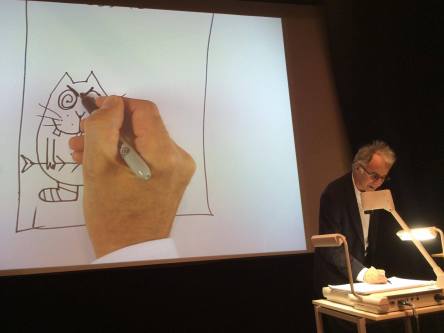
He tells us he will make the talk as much about us as him, he will share several pictures as they say a lot more than words can ‘a picture is worth a thousand words,’ and will be teaching us to draw Old Tom.
He tells us that theory is not his thing, but he will speak to us from his experience as a secondary teacher, a visiting presenter to several countries and his memories of his own childhood. (He shows us a few pictures of these presentations later, with photographs that show the children all having a go at drawing old Tom).
He explains that he writes in an ‘adult’ voice, not as a child. But he likes to have fun and celebrate the ‘absurd.’ He shows that absurdity throughout the presentation with images.
He tells us that his creations are character studies and that he works ‘innately and never writes or draws down to children.’ He doesn’t feel a need to be ‘realistic with his art’ and he totally believes children will relish the opportunity to stretch their minds.
He works with three levels: first the words, second images and thirdly the contradiction between the words and image. Often the image is doing something every different from the words. Interpretation doesn’t have to be literal.
He likes to work instinctively and intuitively. He tells us a funny story about when a student asked him to explain, ‘Why is Old Tom is sometimes very big and sometimes tiny and doesn’t seem to be drawn to scale?’ He asked if anyone in the audience if they knew the answer and another kid explained, ‘that is because Old Tom is big when he is good, proud, happy and small when he is bad or in trouble.’ That is visual literacy!
His character’s size then depends on their emotion.
Hobbs, explains that if children like characters, and they’re well constructed, they will be gripped by them in a couple of pages and make a decision whether to keep going into their world. He doesn’t write with ‘a message’, but rather with ‘real’ characters, experiencing loss, friendship and more .
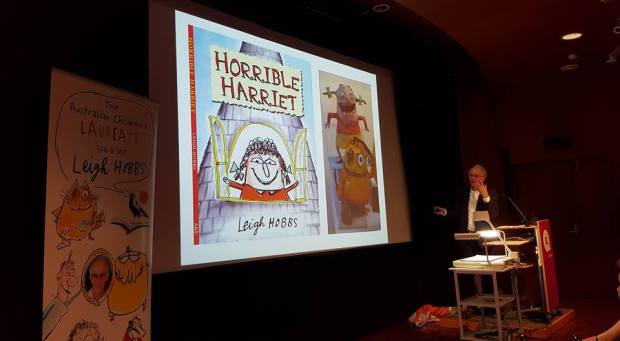
Some of his books appear ‘subversive to adults,’ but children just relate to them as they innately understand characters like Horrible Harriet, the outcast. Not to mention that naughty Old Tom.
Hobbs has had a mixed experience with critics, but it is the children who are the most inspiring in their responses to his work and there was one editor very early on who believed in his work and gave him the opportunity to share it.
He reads us a scathing critique from a prominent Australian newspaper where the writer/reader didn’t display any understanding of the characters in his text, and compares it to comments from some positive kid fans (six and five) in Ireland wrote, including their teacher (30 years old). They asked delightful questions which he savours reading to the audience. He then reads us another adult critic who did understand his book, and loved it. He is philosophical about this and not at all bitter. He talks about the process of how people enter the world of books like his.
At this point Hobbs shows us a picture of himself as a child in bed, reading, with an alarm clock behind him. There are a few aws in the audience. He tells us his parents wouldn’t allow him to draw until it was at least 6am as he drew all of the time. So he would wait for the alarm to go off and then draw.
As a boy he wanted to grow up to be an artist and travel to London. His favourite books were non-fiction books about castles, architecture, and London. He liked to inhabit the worlds in these books. He does point out the Noddy Collection in the back of the photograph (I remember my brother having this set too.) He has been to London over 30 times and that’s why one character, Mr Chicken goes to London. Mr Badger is also created out of his passion for England.
Today he likes to travel everywhere with his notebook and sketch.
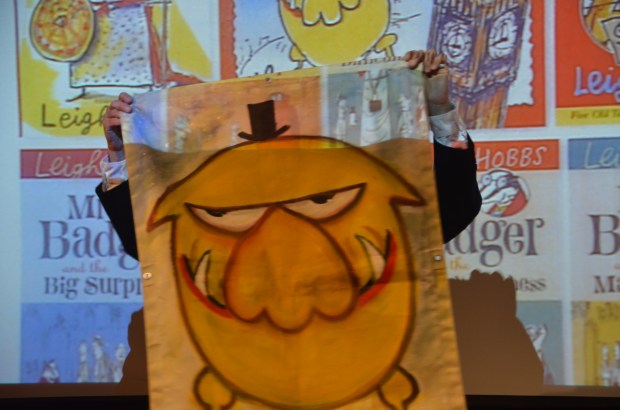
He shows us some slides of teapots with architectural construction and other visuals of things that inspire his art. He always loved architecture and history. He then tells us a bit more of the history of where Old Tom came from (he is maybe a bit based on him and his mum is the mum in the book) and reads us some of the pages of the book as they appear projected up on a screen behind him.
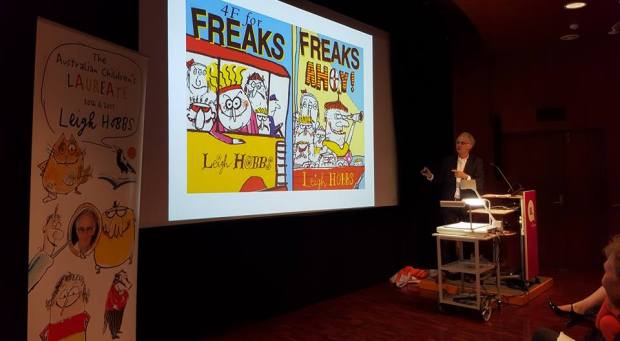
He talks to us about some of the other books, like 4 F for Freaks, and shows us some pictures. He jokes, but is deadly serious as well, that many of these characters are based on kids he knows. Well they are kids we all know if we think about it. Some of the teachers in the audience are giggling now, showing their visual literacy.
He says, ‘kids are scary, ‘the audience laugh. ‘Yes, I don’t like to read aloud to them as they might not laugh in the right places, and then I might stop being intuitive when I create.’ Instead he prefers to teach them to draw and field questions about the characters, which he will sometimes have them answer themselves. Sneaky Mr Hobbs, but maybe there is something in this technique, because it is about not talking down to children! Children can explain his characters and how they are represented to EACH OTHER.
He explains that children read Old Tom and see that the cat is like a baby, a naughty boy, and the mother, a control freak. Angela is lonely which is why the cat is her baby boy. The cat/boy wants to grow up, and is sometimes immature and pretends to be sleeping to avoid things like helping the mother.
He once wanted to dedicate one of the Old Tom books to his mum, but she said, ‘no’ which at the time made him grumpy. He loved his mum but used to fight with her a lot (I think I might have giggled here, sorry mum). When he spoke to another relative about this, they just laughed and said, ‘Mum always complained those books were all about her and you.’
At the start of every old Tom book Mr Hobbs doesn’t assume anyone knows Tom, and so he introduces him.
His pictures are never just literal and he will for instance have a vacuum cleaner with eyes (this flashes up on the screen.) They have an emotional honesty to them.
Then Hobbs, tells us more about Horrible Harriet and Mr Chicken and shares slides of portions from each book. He shows Mr Chicken sitting on a chair visiting the Queen, and sitting daintily and the Queen is depicted respectfully.
Mr Chicken is pretty mischievous and bold too and he shows us some of his adventures in Rome as well. More laughter from the adult audience gathered.
Mr Chicken is in some ways ‘an affront to the adult world,’ but he makes total sense to children (and the children at heart?)
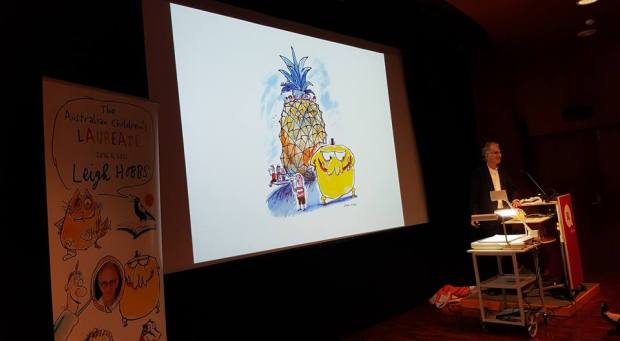
Every now and then he has a comedic break, and shows us things like Mr Chicken now on the loose in Queensland. Could a new book be on the way?
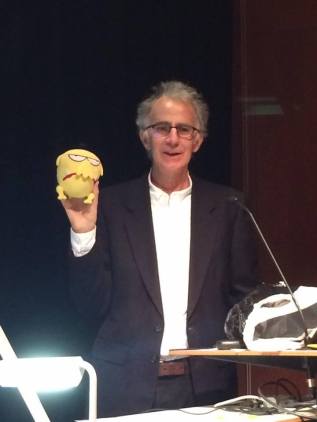
‘Children like Mr Chicken because he is bold and funny. ‘ Mr Hobbs invites us to have pictures with Mr Chicken later and holds up a toy of him.
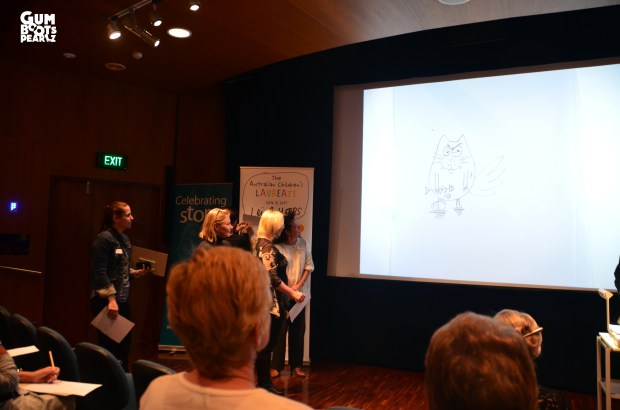
And now it is lesson time. We all learn to draw Old Tom. How to make him angry looking, and mischievous. It’s fun! Mr Hobbs tells us all our pictures will be different and he asks some people to voluntarily show their pictures once we are done. These are projected up for all of us to see.
He makes a few jokes about how the pictures reflect the personality of the ‘feral’ artists, which makes a few people look at their pictures a bit more and giggle. One will later proudly sign hers and share it on her facebook!
Then it is question time.
And in his response to the questions he shares his feeling that libraries are safe havens for many of the kids who feel like freaks at school. They one space they are not assessed in within the school environment, but are FREE to read, write and draw.
He thinks schools spend way too much time assessing! More cheers from the audience.
He tells us a story about one of the freaks of the library days of his school days being someone who grew up to become a famous journalist. The library was his safe place.
He shares that if someone wants to grow up to be a laureate, they should first just be a writer or artist. To foster this you can give those someones notebooks and say ‘draw whatever you wish, observe the world around you and you don’t have to show your book to me unless you want to.’ This gives children freedom.
Mr Hobbs very much believes that everyone has the right to make marks on paper, and be free, which is why he taught us how to draw Mr Tom, but some of those who do this will grow up to be artists.
He likes to think of himself as an artist, not an illustrator, but he does tell stories in art.
There are a few more questions and we find out that his dear old Mum is gone, but she got to live to see her son doing something he loved.
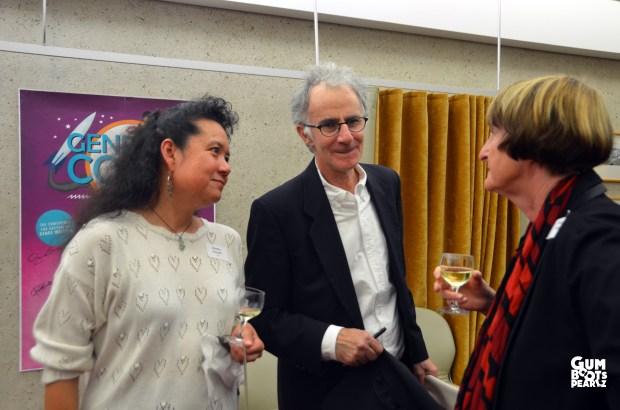
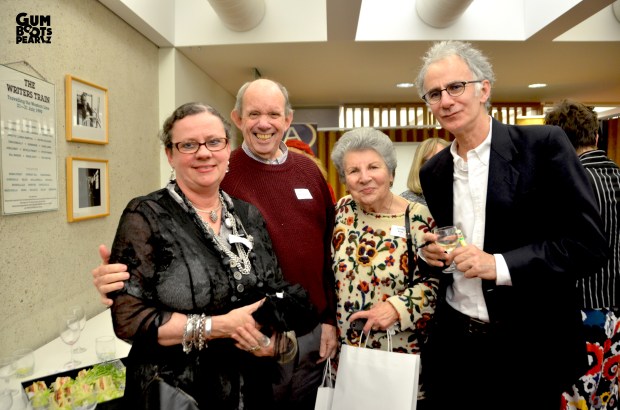
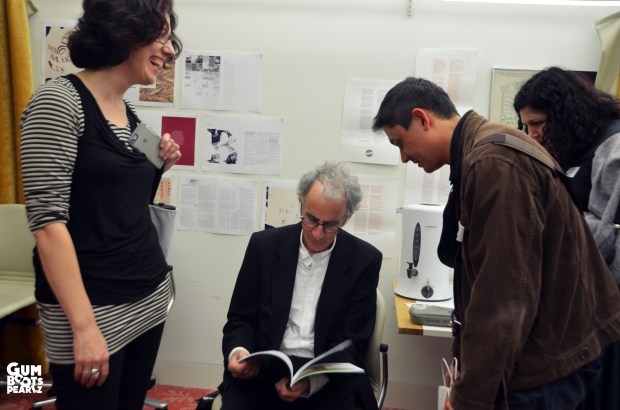
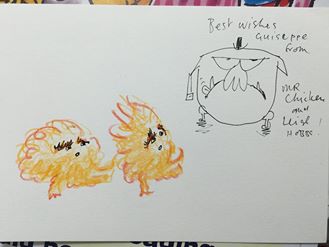
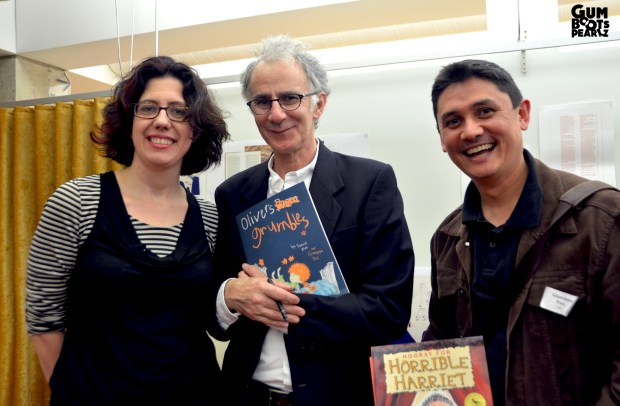
Now we head off for a VIP reception and Mr Hobbs kindly deals with a long line of people asking for photographs and autographs in his books (some of them have dashed down stairs to grab some from the shop.) None of them are children but there are several illustrators amongst them. Mr Chicken meets Mr Grumbles! Another character on paper. A big of magic happens. Giuseppe and Yvonne are delighted.
Every now and then he dashes out of the autograph line to grab a snack and talk to someone he knows and then he heads back to his Laureate duties.
He has a bit of a joke with everyone, and is smiling, and some of us make sure all the food trays are pushed towards him so he doesn’t suffer autograph fatigue. Who would know so many adults would start acting like Old Tom and Mr Chicken? Grown ups can be cheeky!
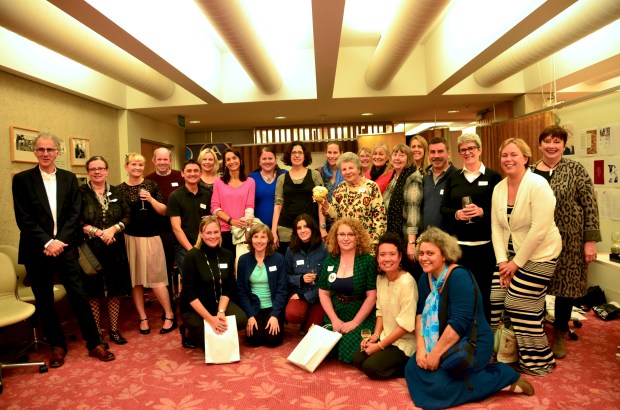
Mr Chicken makes an appearance in the centre of the group photograph, that we manage to call people together for – all wearing their VIP stickers. Everyone seems to be in high spirits and several have the giggles.
Someone makes sure that Mr Hobbs finally gets to eat more food. In fact maybe they are turning him into Old Tom or is it Mr Chicken.
Mr Hobbs leapt across the stage at the end of his talk to become Mr Chicken.
Reception Time
Mr Grumbles introduced to Mr Chicken!
“I had a brilliant evening @ Book Links 2nd annual lecture in childrens literature with guest speaker Australian Children’s Laureate, Leigh Hobbs. I was impressed with the delightful manner in which Leigh Hobbs shared his knowledge and experience. During his presentation ‘The Mystery of Visual Literacy’ with a projector at hand, he got everyone to follow his direction to create our own drawing of ‘Old Tom’ a main character in one of his picture books. He explained that he writes and draws instinctively, saying ‘he doesn’t draw down to the children, he makes them stretch up to the understanding of the image”
Jillanne Harrison
“Creating amazing children’s literature is a whole lot of craft and good splash of magic. After listening to Leigh Hobbs – Australian Children’s Laureate, I have levelled up in craft …and experienced a little bit of magic. Can’t wait to share this with the school kids. Awesome – Go Australian Children’s Literature!”
Giuseppe Poli
You can check out Mr Hobbs in action tomorrow and he was busy there today as well :
As part of the Out of the Box festival the 2016/17 Australian Children’s Laureate Leigh Hobbs is coming to the State Library of Queensland to introduce us to a trove of his Picture Book characters: Mr. Badger, Old Tom, Horrible Harriet, Fiona the Pig and the well-travelled Mr. Chicken.
This blog originally appeared on Magic Fish Dreaming. Visit the blog to read other interesting posts about the project.
Join the facebook page or blog to be informed about the kickstarter.
For Our Children
Helene Magisson is a Children’s book illustrator, who graduated from the painting restoration school “Art et Avenir”, Paris (France).
She was also trained in the art of medieval illumination, exhibiting her work in Europe and teaching the history and techniques of medieval miniature in primary and high schools, both in France and in India, where she lived for a few years.
When Helene settled down in Australia, she decided to start a new career in children’s book illustration. Her numerous trips in Europe and Asia, as well as her childhood spent in Africa inspire and enrich her work. She believes that travelling is a fantastic source of inspiration.
Helene was awarded the first prize in the illustration category at the 2013 CYA conference. She has illustrated her first book, The Velveteen Rabbit by Margery Williams Bianco.
Helene in India
How did you come to work on the Magic Fish Dreaming Project?
One day, I got a message from June Perkins. A long message describing her project with precision. Her approach was clear, smart, graceful and engaging.
She was talking about poetry, places of Far North Queensland, about multiculturalism, team work, and respect. It immediately resonated to me.
So I wanted to know more about her, who she was, and I discovered an incredibly creative and talented woman. I felt that this project could take me into a new world like a door opening to a part of Australia which I was thrilled to discover, through June’s eyes and words.
I had no doubt about the project, no hesitation. It was like something absolutely natural.
Then she sent me her manuscript, and I had this wonderful feeling when each poem suddenly sparkled in my mind. My imagination was flying far away.
The connection was done straight from the first poem.
What appeals to you about this project?
Many things appeal to me.
I always wanted to illustrate poetry for children because there is no limit for the imagination. It is playing with words and images. I think it is a fantastic way to make the children aware of the beauty of the language and the words.
And I love June’s poems. They are so rich – with a mix of humour, gentleness, mystery, depth and a lot of love and admiration for the Far North Queensland environment. I also can feel the soul of a country in it. There is the mystery of a tree, the beauty of a majestic bird, many strange animals, and also children from different communities.
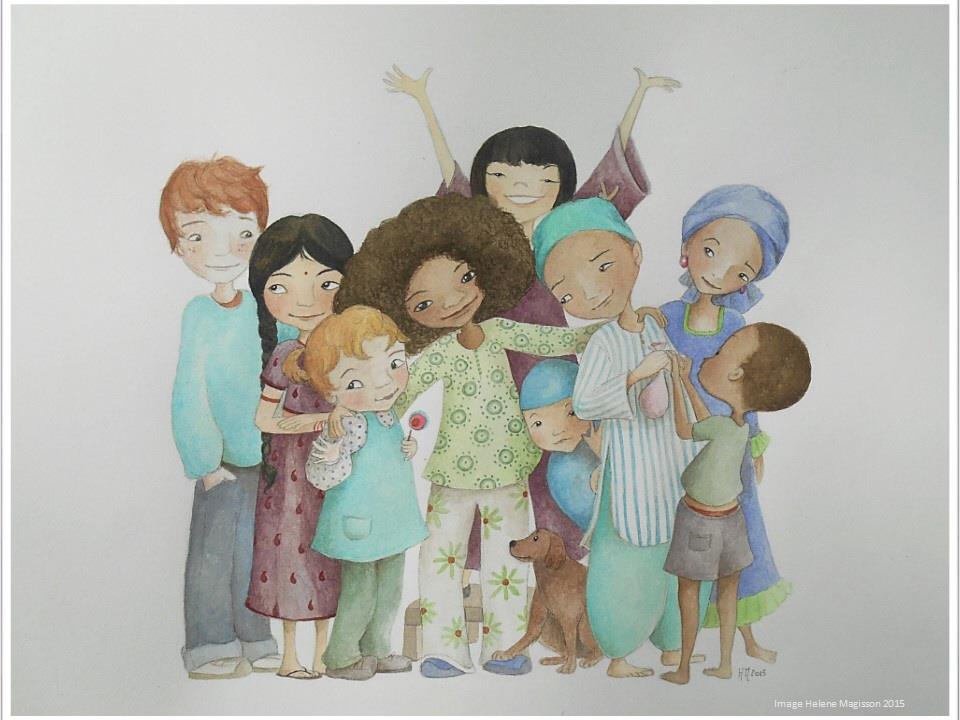
When June approached me I really liked the fact that she highlighted one of my illustrations I called “For our Children”. It is an illustration I did a little bit after the terrorist attack in France.
There are nine children coming from all over the world (India, Pakistan, France, Ireland, Australia, Kenya…), children I have met in the different countries I have been living in or visited, and they are altogether, smiling, teasing, hugging. There are in peace and happy.
June liked it for its multicultural dimension. She wanted to highlight that in the project and that really touched me.
I love the idea to mix Aboriginal, Italian, Torres Strait, English, and Australian children.
It is poetry for all and everyone in a beautiful and peaceful environment.
I feel so fortunate that this project came to me.
What kinds of things did you do or are you doing in illustrating the poetry text for June?
I ask June to tell me more about the poem I start working on. What is behind the text, and how she came to it. She also sends me some photos (she is an incredibly talented photographer too). I collect a lot of ideas from them.
In her photos, she sometimes focuses on a detail, a beautiful detail seen from another point of view. I also see that in her poetry, and I try to transmit this idea in my illustrations.
Then I work on a few ideas, keeping in mind the authenticity of the Queensland environment but then I try to “translate it” in a way to appeal children with the choice of the colours, adding amusing details, hiding animals.
I propose a few roughs and we decide altogether (including June’s editor Matilda Elliot) which one will work the best before I start working with colours.
What is your background with working with understanding illustration that is appealing to an audience of children and their families ?
I studied restoration and history of art and worked as a painting restorer for a few year, this gave me a strong background in my art work but there was no place for creativity.
I think I always loved children’s books. It started from my childhood in Africa when my mum was reading to us all the Andersen, Grimm and Perrault’s tales, even a little mongoose was coming very often to listen.
So I did the same for my children when they were still small, reading all sorts of stories at bed time. I wanted them to be touched by the story but also to be open and sensitive to the quality of the illustrations. And there are so many incredible books that inspired me to pursue this dream,
Also when I decided to illustrate children’s books I spent many hours reading and looking at picture books because I wanted to understand how the illustrations process was working page after page and how to create an interesting relation between the text and the illustration. The more I discovered, the more my passion grew.
And when I felt ready, I attended the CYA competition in 2013 and was delighted to win First prize in the illustration category.
A bit later, I illustrated the beautiful and very well-known classical tale “The Velveteen Rabbit” by Margery Williams Bianco, published by New Frontier. And I am excited that next year three more books I have illustrated will hit the shelves, including with the help of all our supporters, Magic Fish Dreaming.
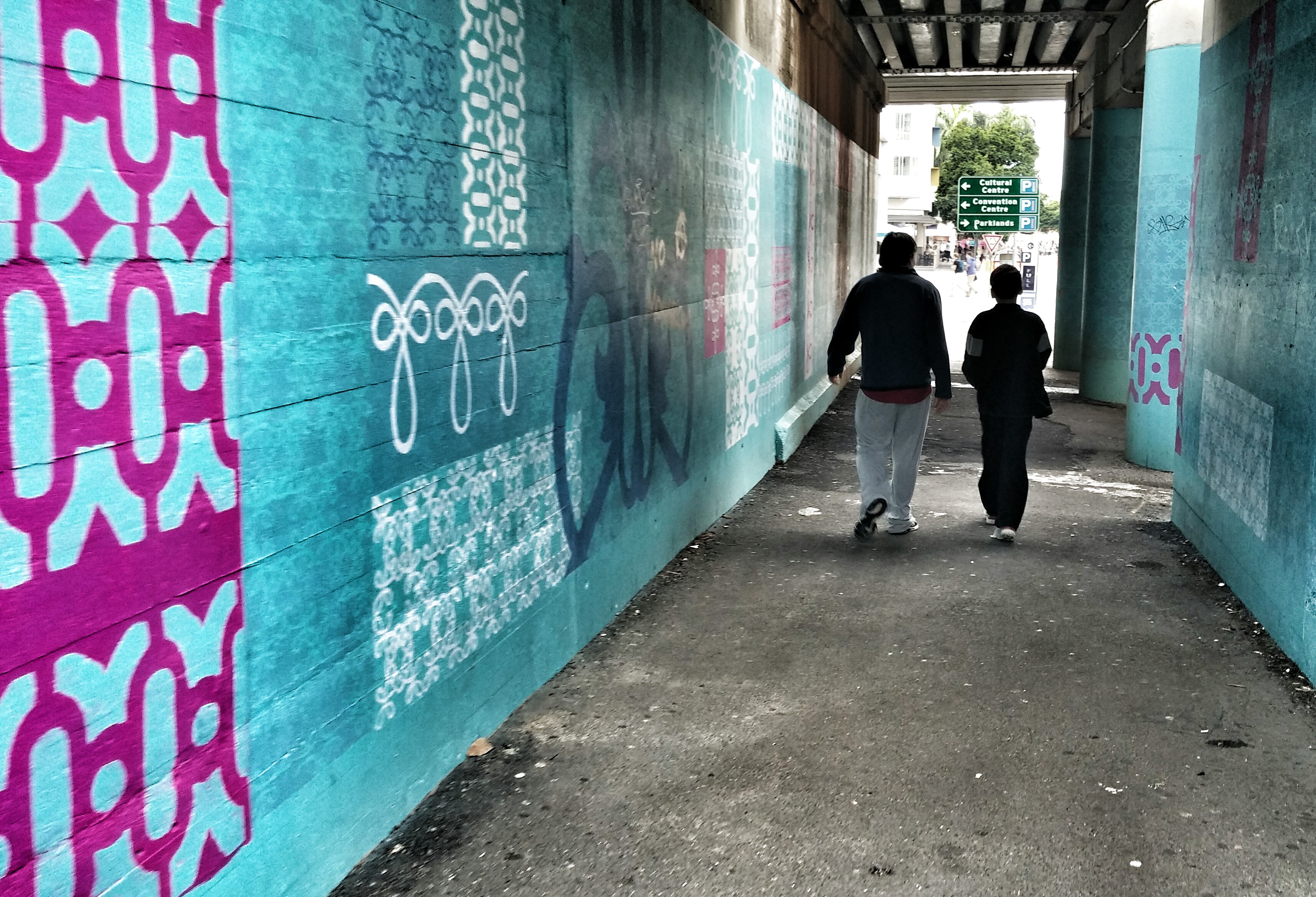
One of the things I love about cities is discovering the art in the underpasses and on the railway stop walls. Some of these art works are commissioned creations; others are layers put over already existing art and blank walls by underground artists.
During the lead up to hosting the G20, the city concerned about how the world might see us, made an effort to add to and raise the quality of the underpass creations; while headlines proclaimed the blandness of much of the existing street art.
I still have to make it to some of that new art created, but for now I am noticing street art whenever I pass by it with my trusty camera phone.
Street Art doesn’t always last for long so I could make this a long term photography project and visit some of these spots again in three years or so and see if they have been painted over with new designs.
I definitely better make it to the Merivale Street Creations– for a follow up post; these ones are probably going to last about eight years and they look stunning in all the online documentary photos I have seen of them.
Perhaps in this journey I may meet some of the people who create these works or even happen upon the creation of one in progress; that’d be brilliant and something I’d love to film, although I think I’d be going for the legal projects for all sorts of reasons.
 Minaira Fifita
  Art Work by Ruha Fifita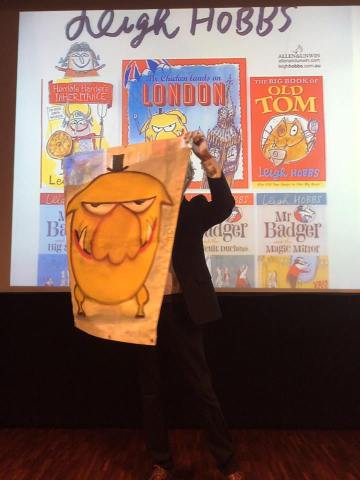


 June Paisa Perkins