Sunshine after recently reading my last post encouraged me to do more adventures in poetic form, a great idea really to limbre up my writing muscles.
Today I am trying nonets – a 9 line poem starting with 9 syllables on the first line and contracting by one until you end with one syllable. I wonder which form will attract me next, or if I’ll stick with nonet’s for a while – we’ll see how I feel at my next warm up.
Jody McNary- Flickr Creative Commons
Alone
The girl with a flower in her hair
Motioned moonlight to visit her
Dancing light beams touched her face
Stillness touched ruby lips
Froze tears to her bones
Love still for her?
She could hope
And dream
Alone
Once upon a time my children and I played you-say-a-line-I-say-a-line, stories. It was amusing, imaginative and kept us all on our thinking toes, although my daughter had a habit of killing lots of our characters until we had created on that she liked.
But years have passed and we haven’t played the I say-a-line-you-say a-line game for ages!
A couple of days ago I shared a story idea with my daughter and she became excited. She was delighted with a creature and character I had invented and, being an artist, was immediately keen to draw them both in action.
She so loved the idea of my first two characters (a good sign I trust) that she enthusiastically began to look up names for them and several future characters and take notes!
‘They have to mean something Mum and then we can try different languages,’ and she popped along to some online translator which had audio of how the names would sound.
‘Do you like this name?’ Many words were clicked on, and the computer voice sometimes with a charming accent read them for us, and then we’d vote.
Now a writer of ego might have said –‘this is my story’ but she represents my potential readers and so she is very important to listen to.
Can’t tell you too much detail of our conversations, at this stage they are top secret!
Before I knew it my youngest son heard us laughing, haggling over the characters and generally having fun like the old days, and popped in to see what was going on.
Soon, at his insistence, he was involved and mapping the world. There were mountains, forests, and more. My children had become engaged readers keen to take ownership of a creative world in the making.
The story I shared with them had become a collaboration. Our past had become our present but now as my sage daughter noted ‘we are more sophisticated now.’
I created a world, and they began to help me fill it out, and paint it. I felt a connection to two of my readers, or should I say co-storytellers.
I am ready to embark on the journey of this story and take two co-creating travelers with me, although as group leader, they do give me final word on things, after a bit of to and fro.
Not to mention I can work on it when they are at school, in some peace, until they have their next input.
US Mission Geneva – Human Rights Performance Installation
A signature style lets me know that I‘m reading particular writers’ work.
I just know when I’m turning the pages, via paper, or ebook, or scrolling a webpage, that I’m in their company.
Their styles may draw on set patterns of a genre (romance, fantasy, crime, young adults etc.), but their writing will still have their particular writing personality.
Think of the writers you like most. How do you know it’s them?
Why not take a moment to think more deeply about the writers you love most and reflect on what you can adopt from their style. Although you might approach them usually as a reader, look at their style now as a writer in the process of becoming.
Now say you are writing memoir, why not explore some memoirs of people who might be like you, or have had your same experience. How do they write of it? As you read, reflect, and pay particular attention to the following: • The pace of their writing (does it move fast, medium, or slow) • Their attention to character (what kinds of things do they focus on in people) • The way, and how often, they deliver a description • How you are like them • How you are different
Ask yourself: • Are they poetic, matter of fact, obsessed with fine detail? • Do they use many colloquialisms or cultural proverbs? • Do they use a formal style, or a relaxed and chatty one? • Are they a slave to genre or challenge the genre they write in?
The same reflections and questions can be applied to any art form, including cinematography, video, sound editing, and so on.
Finding one’s own style can be gained through studying, adopting and adapting the style of others one admires – but ultimately at some point writers/artists and filmmakers benefit from knowing and becoming themselves. (Although one could argue some writers thrive on not knowing themselves at all).
Finding style then becomes a quest for a unique writing identity – and voice. •Who are you and what do you like to read and write? •Are these two things the same? •Who are you going to become?
A new set of questions can be asked to assist in your quest like: •What don’t you like about the writers you mostly admire? •What kind of things do you hate to read? Why? •Now be honest – do you ever do any of the things you hate reading in your own writing?
When you have spent time thinking about who you like reading and why, you are one step closer to developing a writing signature that will set you apart from others.
The process of creating your signature may not always be easy. It involves analysis, practice and creation.
It is about communicating, performing, reflecting and refining, until the signature becomes unique.
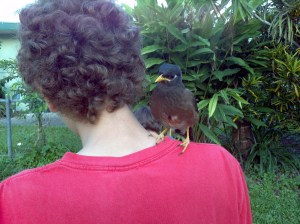
The bird listens to the song – is calm and quiet, sometimes it even joins in.
It may sense a prayer – for it is gentle and still.
It sleeps even as the song progresses.
Caged bird – if only it was free, but to be free would be to be a pest, to be hunted, because it doesn’t belong here.
It kills all the natives.
Bird – are you a metaphor for all colonisers everywhere?
Caged, uncaged, let loose, like a kite whose string is cut when it’s up high enough to be free.
If only the bird could go back home. Find somewhere that welcomed it, beyond the shores of here.
Sometimes when the bird is free it pecks the eyes of the youngest – he cries out and so the bird is punished.
But when his master comes home – he who feeds it, advocates for it and reminds his mother she must feed it, and play music to it – the bird is attached to a shoulder where it belongs.
The bird loves them all though, even when he pecks the youngest. He hates toes though.
Toes mean treading on bird when he’s running around out of his cage. He lives for the forage, the chase of the bug – preferring grubs you throw and make look like living worms.
The bird belongs in this family – but are they a cage outside a cage? What is the bird was truly free and back in his homeland?
The question has no real answer because life is what it is and the bird was born in foreign lands and fell from his tree. Now he lives here – and rests in his cage.
To be continued.
Self reflexive
Sometimes I like to write from the environment around me, like writing a storm when one is on, or basing a character upon somebody real. Today I wrote of our family pet bird and his relationship with our family and his environment. My next challenge is to incorporate this into a developing story – and the obvious place to go to after the bird is inside the head of one of his family – but there are less obvious things that could happen – like going to the head of his mother? So until my next blog post in this story I will be thinking and dreaming about what I could write next.
Cliche Busting
An uncaged bird – as freedom is cliche so I have made this that the uncaged bird is less free than the caged because of what waits out there for him. I would have liked to be more humourous but today there is a melancholy tone in my writing, it could just be my choice of metaphor.
I asked my youngest son to plant a dream seed. He said “I want to play cricket in South Africa!” I did not tell him it was an impossible dream instead I said “So what do you need for that- can you draw it for me.”
He drew me a cricket bat. Then we yarned some more and he said “I can learn to speak South African.”
Then I spoke about Stephen Waugh “Who’s that Mum?”
“He was the Australian Captain and he met Mother Therese and said she changed his life.. because then his philanthropic work became more serious.”
“What will you do when you play South Africa.” Mummy planted a dream seed next to his dream seed.
I asked my daughter to plant a dream seed. She said “I want to meet a dragon.” I said “A dragon lizard”. She said “No a DRAGON,” so I said knowing she is also interested in making robotic limbs “Well maybe you could make a robot dragon or an animated one,”
“Oh yes., a big robot dragon that looks really real! with muscles and a skeleton..”
“And what will you need for that my little one.”
“art and computers and science ..”
Together we could just see that Giant Robot in an awesome movie!



 June Paisa Perkins