To play, to dream, to collaborate – the collage above involved all these three things, and was a result of my son’s brilliant idea to play Robin Hood and have me photograph him.
Today he is away on a camp for leaders, and no there is no archery set with him, but he is going to do some wall climbing and other team building exercises. He will be away all week.
It is too quiet around here!
He is growing so quickly and I am proud of the young man he is becoming.
I remember days as a child when I would play act in the woods with my friends. We were Robin Hood and his gang, hiding in Sherwood forest. We were going to make the worlds a better place. But it is not really as simple as robbing the rich to give to the poor.
Still Robin Hood’s mythical sense of justice , chivalry, and helping the down trodden is something that can be admired, even if his methods involved a lot of bow and arrow.
Seriously, what can we learn from Robin Hood ?
1- Legends can be reworked, reimagined until people find them real in their consequences
2-Robin Hood changes to fit the day and age, sometimes he is a philanthropist, sometimes national hero
3-Archery is cool!
4- We will never really know if there was a real Robin Hood.
5- Nottingham gets to have a cool tourism attraction.
It was just so rewarding and exciting to assist my friend Danielle Wilson by filming behind the scenes of her project Dance for Recovery. She was supported in her vision by two community arts workers, Avril Duck and Melissa Robertson working for Connecting Community Voices, ISAY project, funded by Far North Queensland Volunteers inc, and several other creatives in music, sound and film: Dez Green, John and Mark Edwards. A couple of members her dance class and some of the wider dance community came to participate, although not all participants were dancers and this was not a requirement.
There was a fantastic response well beyond the circle of Danielle’s friends (most people attending did not know Danielle or each other) to attend this workshop and some people had heard about it on the radio, through the newspaper or the web or through friends; the workshop gave the chance for many people to connect beyond their immediate home. Danielle is all about accessibility and so the class was open to everyone over the age of sixteen. Danielle said she loved that the workshop brought people together from Cairns, Cardwell, Mission Beach, Tully and Innisfail, to express and find their emotions about the cyclone and release them through movement.
Dance for Recovery – Photographs by June Perkins
I have known Danielle since taking my children to her free movement classes in Mission Beach when they were little. She still works with children but has branched out to work with adults and so Dance for Recovery was an important extension of that process. I vividly remember the way in which she created a sacred and creative space for children of the Cassowary Coast to express themselves and my children have never forgotten the classes. I knew the participants were in for something special even before we had begun. Danielle and I had been talking about a collaboration at some point as I wanted to experience photographing and filming dance, and Danielle wanted to document and be creative with making a dance film. It was amazing to have this opportunity to support a friend and work on my own creative practice. Danielle and I have often crossed paths at workshops for writing, and other projects in the Cassowary Coast and we respect each others arts practice.
Dance for Recovery – photographs by June Perkins
Even as we speak Danielle is looking at a draft mix of some of the footage as well as still photographs I took of the workshop Dance for Recovery. I so hope that she is happy with how I am beginning to piece together the story of the project. I am looking forward to working with Leandro Palacio from ABC Open who makes some amazing films that have quite an artistic flair to them. As we filmed on Thursday Leandro especially encouraged me to experiment with my perspective, work the height of the tripod and develop a steady hand-held technique, he directed me to move, just like the participants guided by Danielle in their dance.
To prepare for working on the edits with Leandro I thought it would be helpful to sift through 23 minutes of footage and find the parts which:
1- Help convey the story of the project and performance.
2- Look varied, creative and arty and have some continuity with each other.
3- I am pretty sure he has sound to as my camera has some limitations with how well it collects sound.
4- Are free from camera shake or wonky hand-held technique.
5- Do a draft premix longer than we need to try out some editing techniques and mixes for the final documentary.
6- Look at doing a longer interview with Danielle, either me or Leandro can do this, I could maybe pop over to Danielle’s to do this, she was pretty tired after the workshop.
In the process of filming and photographing I was sensitive to the participants, especially due to the topic of the workshop, cyclone, recovery and finding calm, and Danielle let participants know who I was and that they could opt out of being filmed and that I was approachable and wouldn’t mind whatever their decision. I look forward to their responses to the final documentary as well.
It was great that everyone, participants and artistic support, seemed keen to help Danielle by being in the documentary and a few were happy to talk on camera afterwards even though they were on the way home after long day. The rest of the time they forgot I was there and just went about their workshop. It’s always good for a documentary film maker to be invisible and exist primarily in the movement of her camera! A special challenge with filming this documentary was working with the concept of faceless portraits, and avoiding the human face as much as possible.
June Perkins
Dance for Recovery was funded by FNQ Volunteers, Queensland and Australian Government, Isay project, Connecting Community Voices, and involved many volunteers and a small budget for production for contributing Artists.
Holidays in the Country, so if we like we can visit waterfalls, beaches, listen to the rain, jump up and down in the sun, check out the lastest wildlife in our garden, play on the basketball courts, visit the library and we can LIGHT PAINT all of the previously mentioned and more.
ABC Open has a monthly photography challenge, and they are inclusive of any contributor who wants to have a go, follows the guidelines, and put something up in the ABC Open camera Club. This month’s challenge Light Painting.
There are some amazing and sophisticated contributions from individuals like Daniel and art collectives. As for me and the kids well we started off simply to learn how to paint and yes we did use a TRIPOD. We have bought some more cheap LED lights, and have some more ideas to put together before the close of the project on Saturday. Now that we can do the following paintings we’d like to attempt something more complicated and have the whole family busy drawing until the camera clicks!
True Colours – By June and kids
For handy tips on how to do this check out HERE. I wonder what next month’s photography project will be.
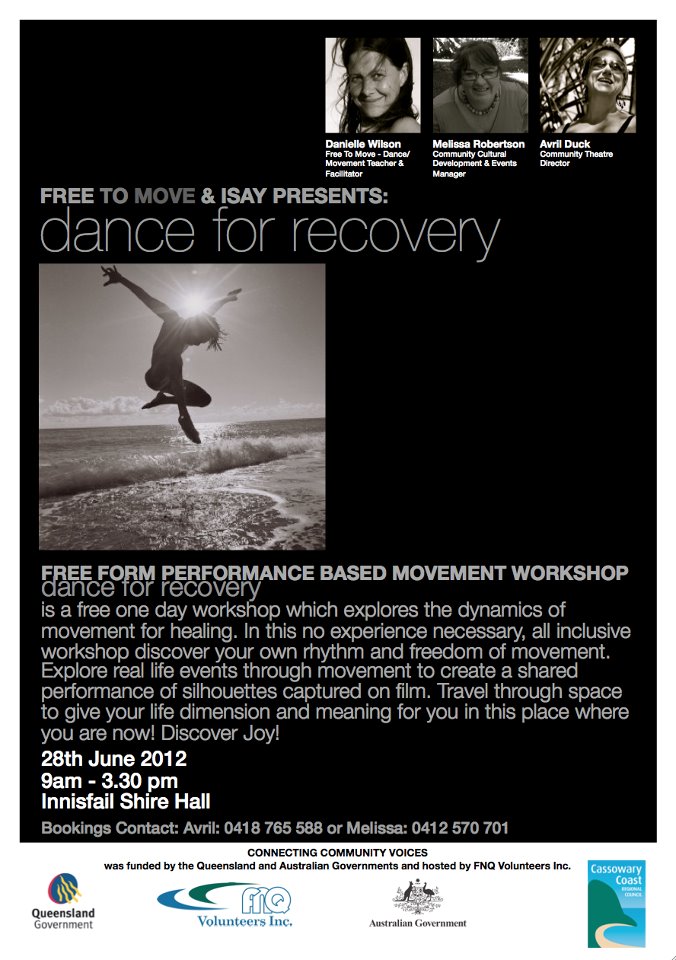
A creative workshop designed for inclusive participation – created by Danielle Wilson, who also takes Free to Move Classes in Mission Beach. Isay supporting and some other creatives will be coming along. Find out more from Melissa and Avril. If you live in the Cassowary Coast why not book!
Should be awesome! Watch this space for some reporting back.
Mother bird chases the sunset. She remembers when she was a young bird. She sees the feathers of the lost brothers and sisters in her dreams.
She made it. She stayed in the nest and was fed and cared for. Most days she barely wonders about where her brothers and sisters went. There are too many other things to think about. Like, what she will eat?
She does not know she is one of the worst 100 feral pests. She does not know many plan her humane death.
She is singing and looking at the other mynah birds on rooves of the houses. She is going back to her home.
The native birds watch out for her, because she is mean. They are keeping clear and will come back when she is gone.
Sometimes she sees a bird just like her with humans. ‘What is that bird doing?’It chases her away and then the foolish bird is stuck in a tree.
She laughs at it waiting for the humans to rescue it. It is like a pet cat. Silly, silly bird.



 June Paisa Perkins