It has been wonderful to have a space to focus away from the distractions of my home based writing space.
It is especially precious as next year I hope to be a part or full time teacher for English and humanities and on the days I am not at my residency I put in job applications.
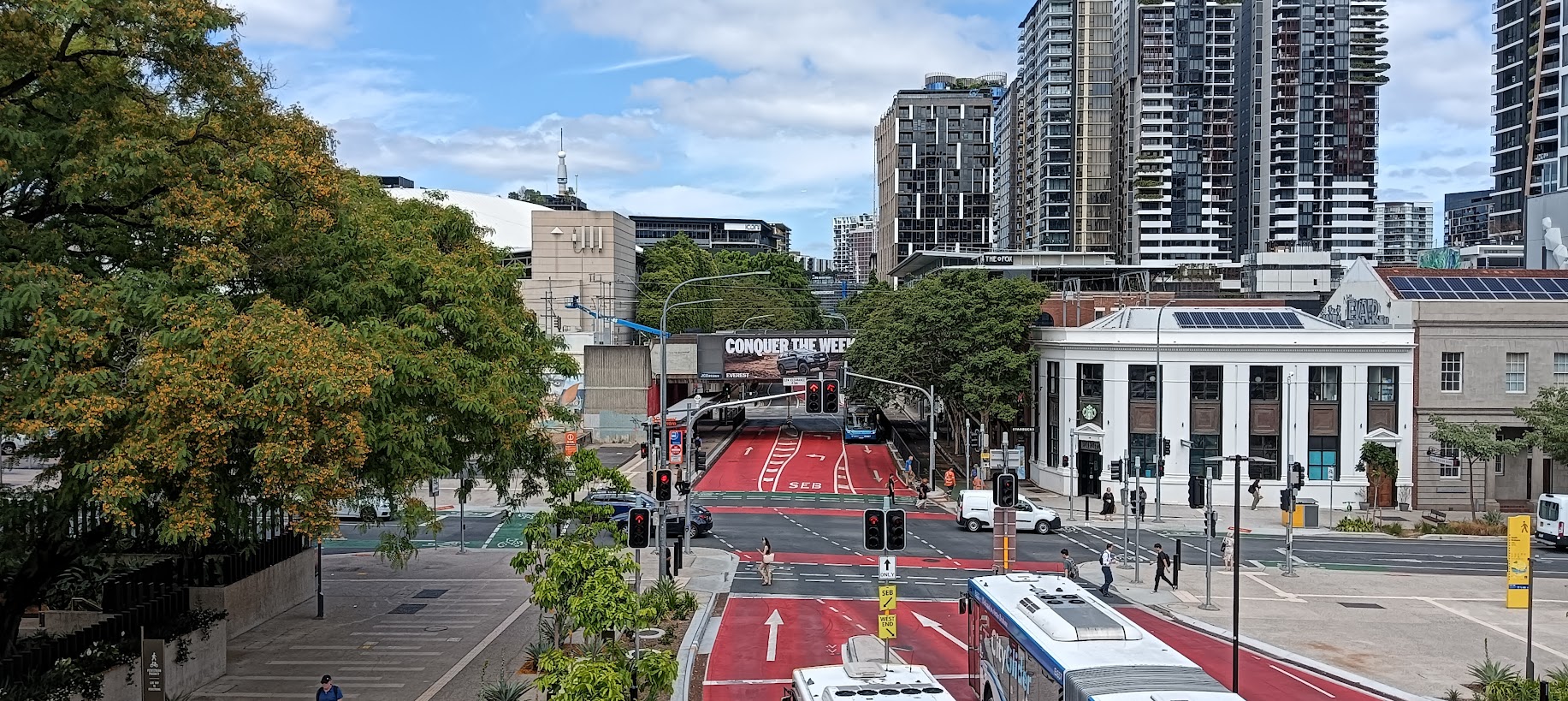
I love my bus and walk into the centre. I loved seeing the above sign one day which seemed to have a special message for me!
And I did feel like I ‘conquered the week’, with a chapter draft and a few poems in draft phase done.
Moving into the second week I found myself beginning to annotate some of my drafts and thinking of how to bring the sensory and lyrical elements I was striving more into my writing.
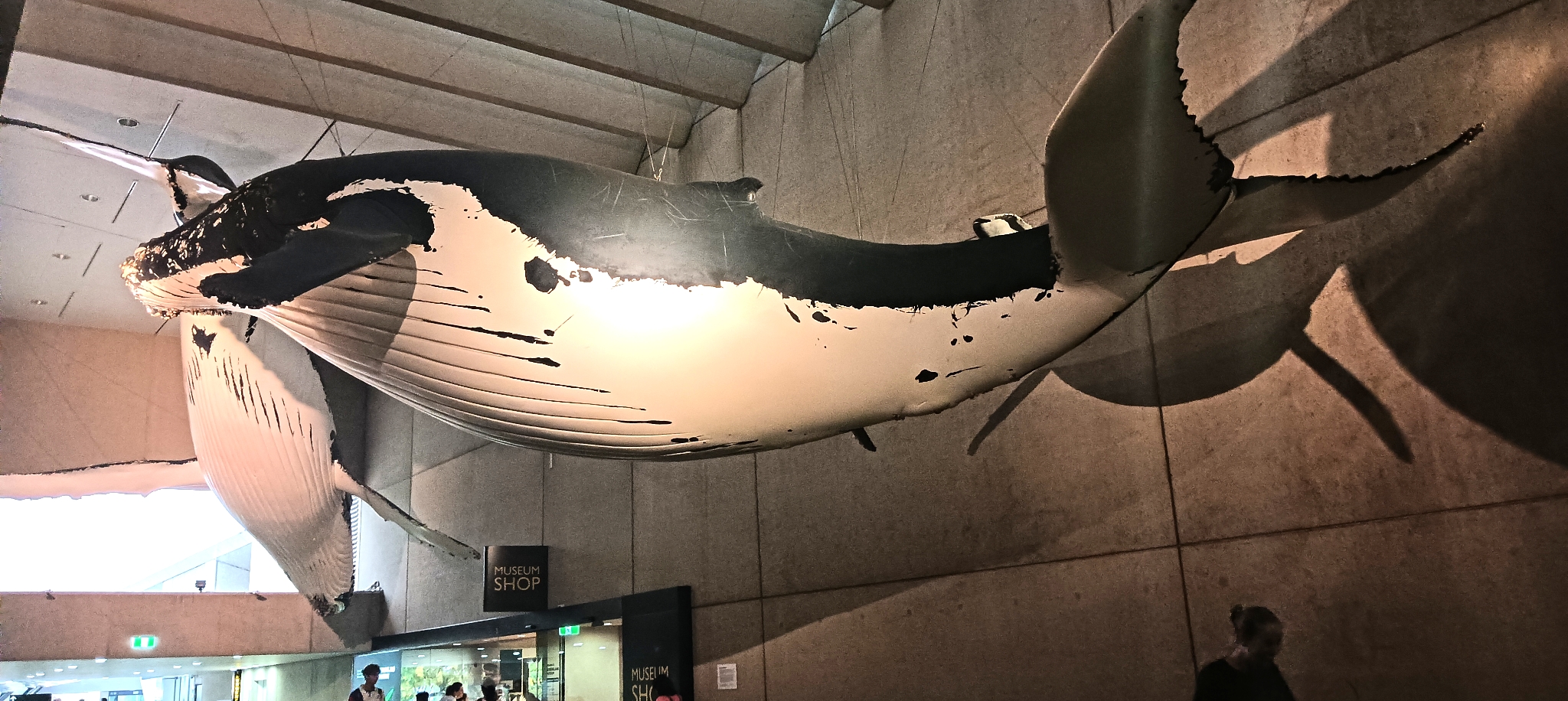
Listening to the whale song recording outside the museum, usually on the way home reminded me of the powers of the auditory.
During the residency I have found listening to music whilst I write settles and focuses me and I do have particular favourites. My musical tastes are eclectic, and I accidentally had my headphone jack not in properly on the first day much to my horror.
I was so much in the zone, I had not noticed. Luckily also everyone seems to like my writing music playlist!
I check it carefully all the time now!
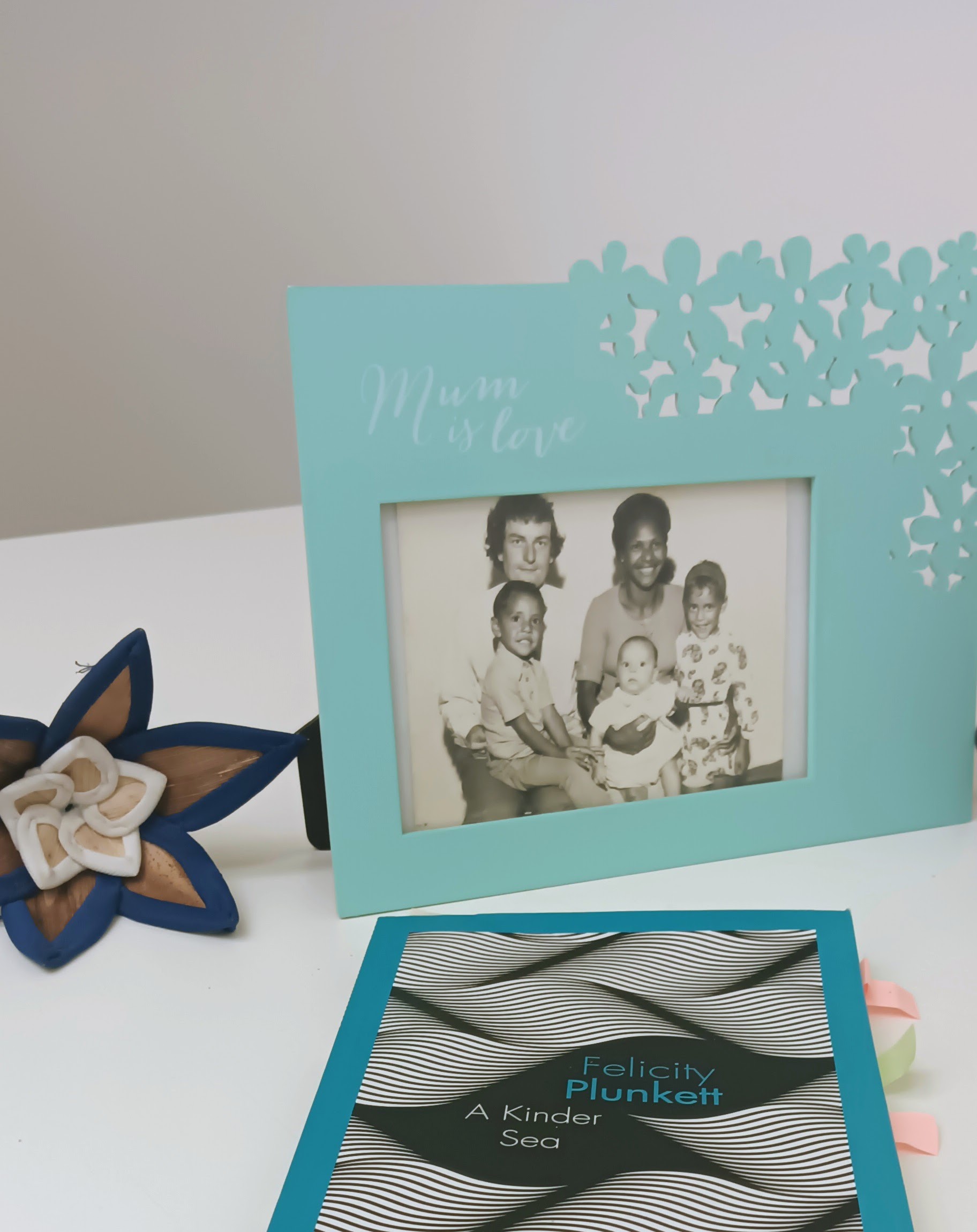
This week I have been reading some of the work of an Australian poet, who writes using thoughtful and beautifully crafted sea metaphors and is a fine poet Felicity Plunkett.
Plunkett’s work also uses epigraphs brilliantly and has some wonderful techniques within it that I admire. I have placed little tags on some I want to revisit.
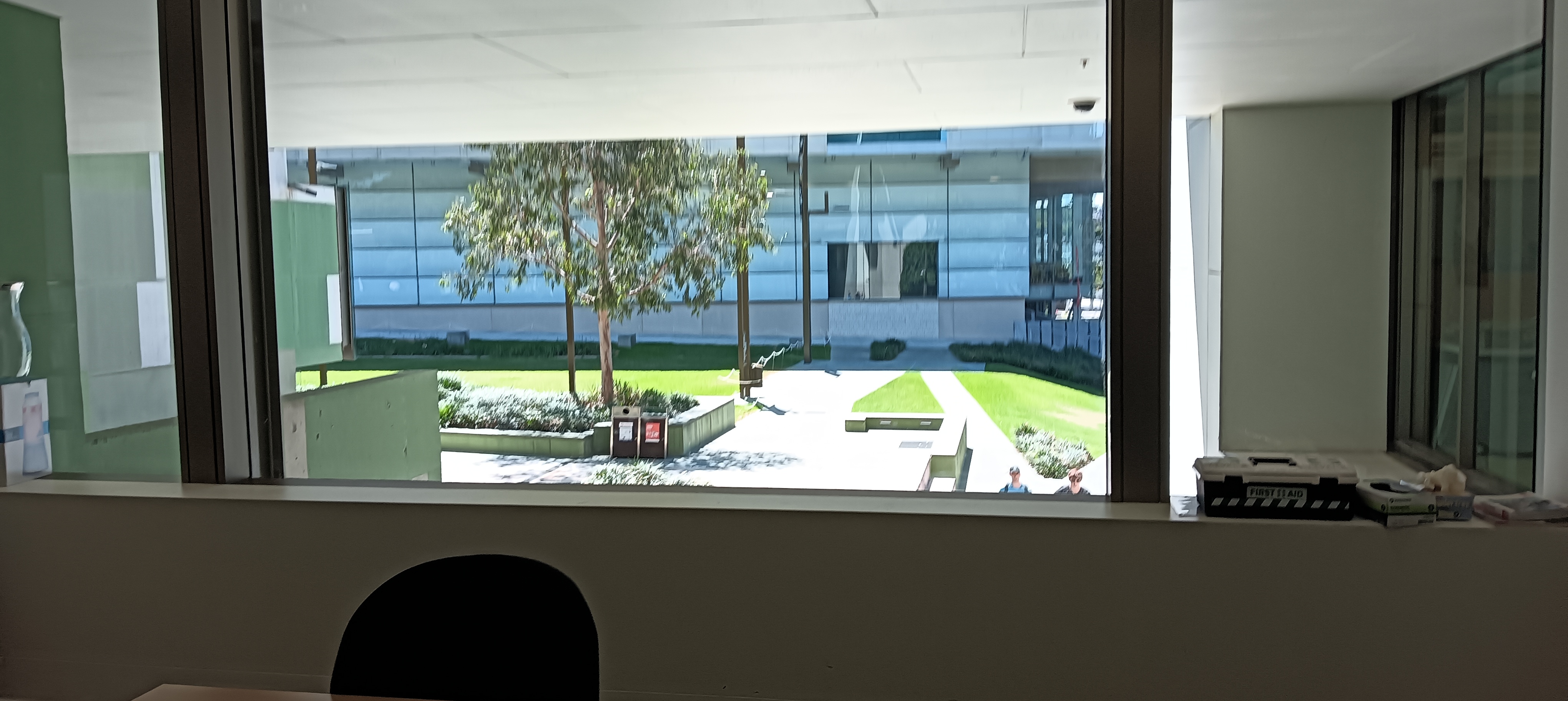
Something I enjoy doing when I need to take a breath from writing, is heading to the break room and peering out the window.
Another is spending time at the fridge, playing with the fridge magnets. One day I was thinking about what voyages can birth, and one of my drafted chapters includes stories about traveling recently to Tonga for the first time.
To keep my mind nimble, I move between memory free writes, reading and researching, looking through journal entries and today I am likely to look through this blog as well to see what gems may lie within in terms of memories. I also do a few stretches and sometimes walk around a bit.
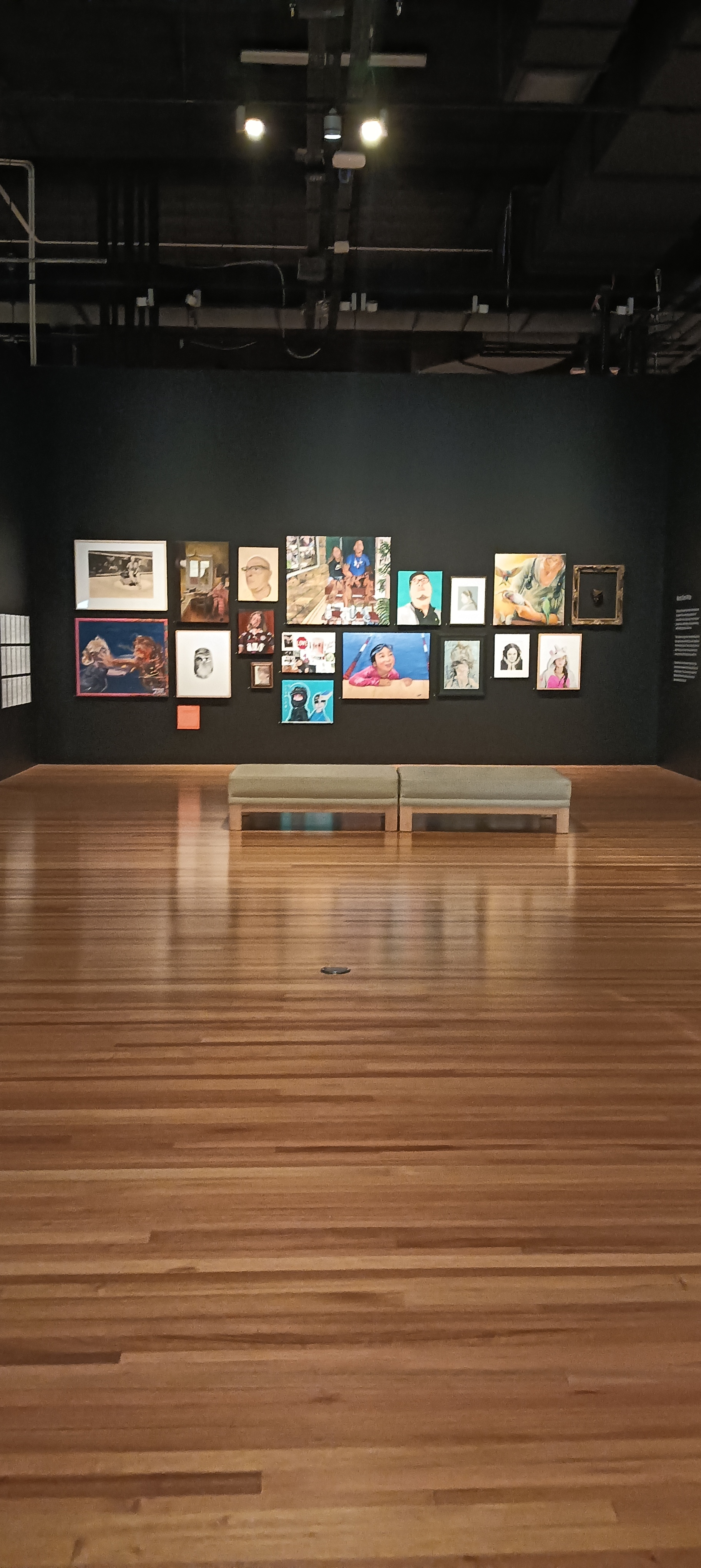
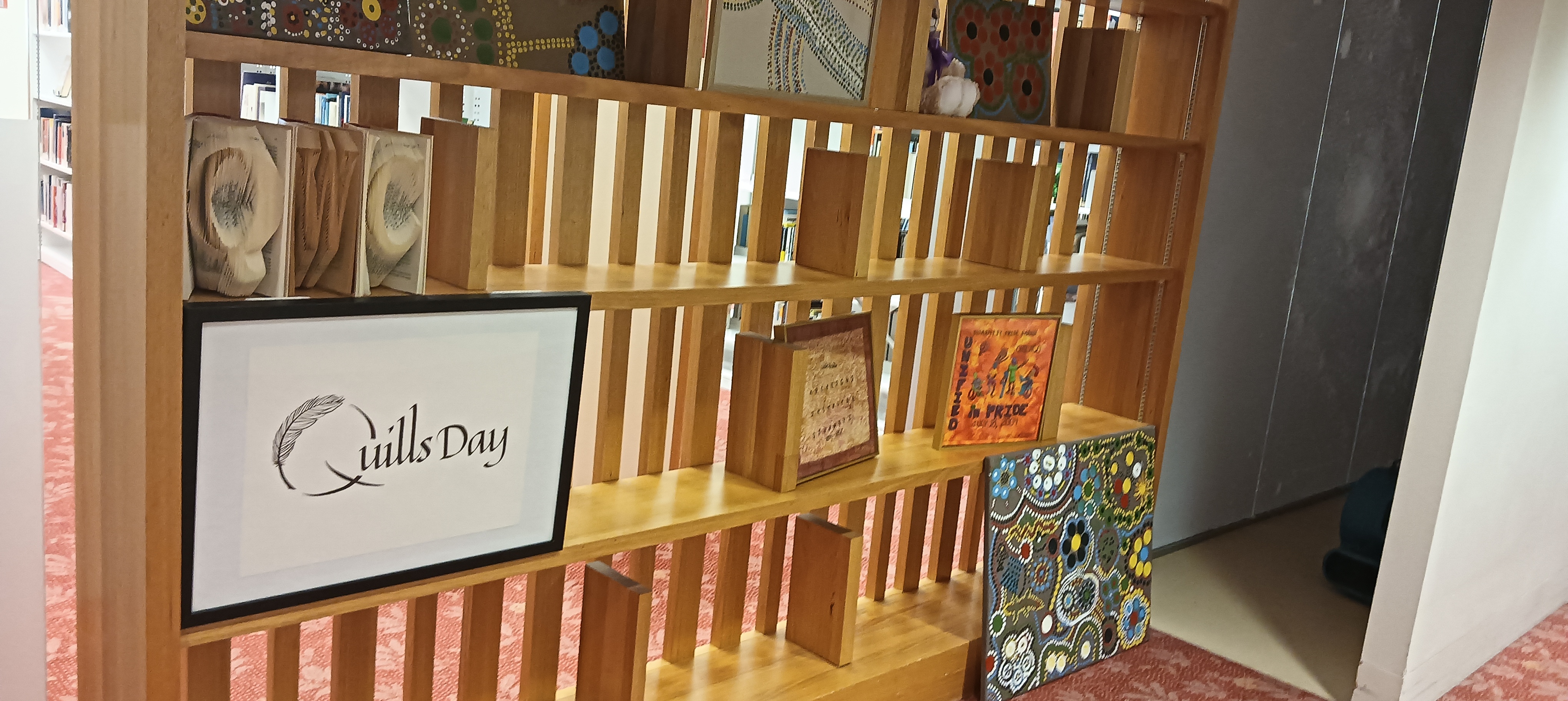
Another inspiration is checking out interesting things in the state library like exhibitions, and things within the writing centre itself.
So the amazing thing so far, is that I have three drafted chapters and many poems in progress. Before I began these three chapters had a page of scatty thoughts, a synposis and a title. Now they are coming to life, as words out of my head and heart and onto the page.
Many thanks to the Writer’s Centre for the Opportunity to do a Fishbowl Residency.
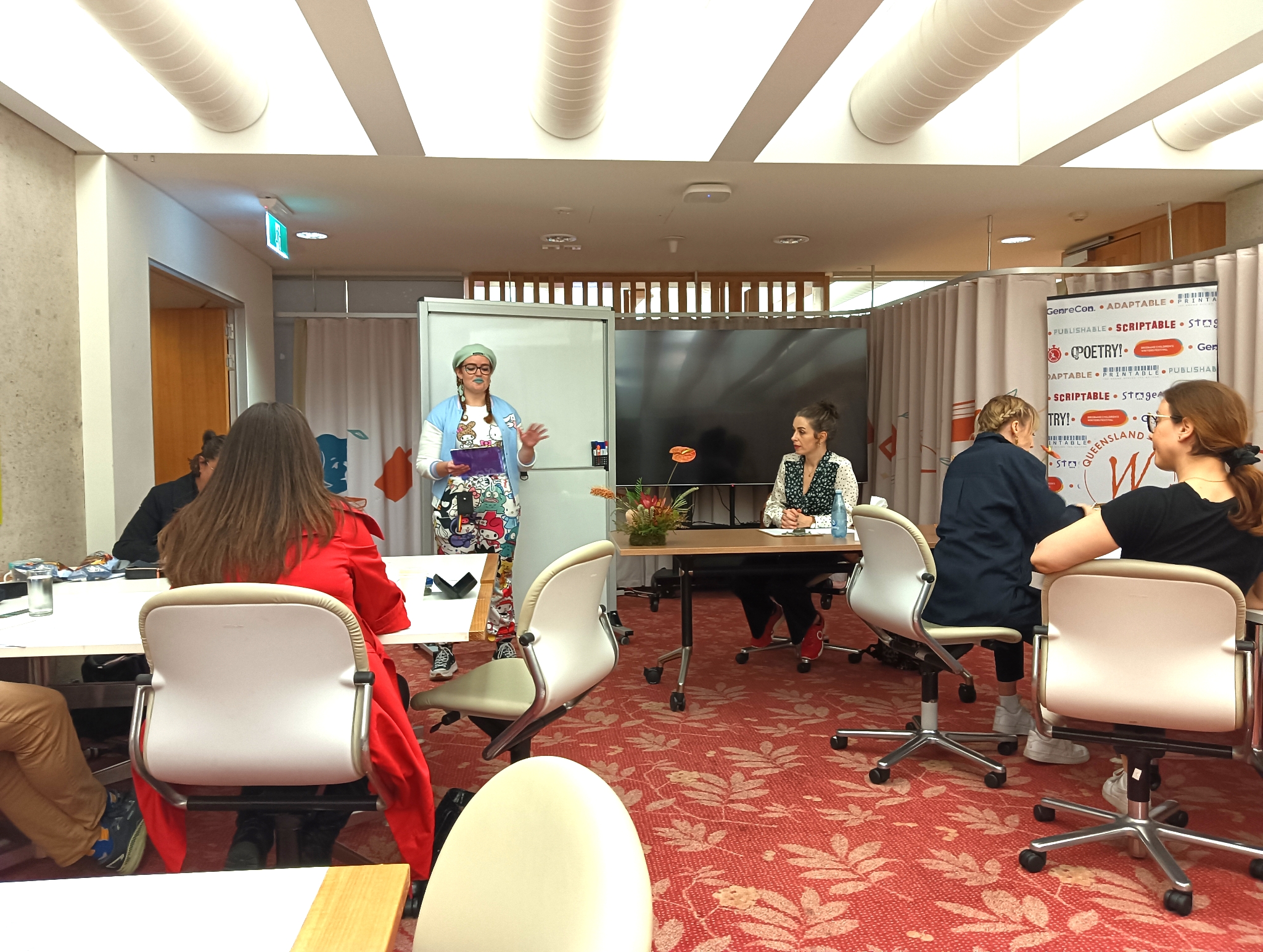
Lizzie introducing Victoria 9th of August workshop at the Queensland Writers Centre.
I am so grateful for the 4000+ words of new creative poems/writing generated from recent Stroke the Monster’s Back workshops with Victoria Kennefick David Malouf Poet in Resident at the Queensland Writers Centre for 2025.
I have potentially 4-15 poems, depending on what I chose to develop from my materials. Workshops always remind me writers need to be careful to not rely on just working alone. There’s so much energy, inspiration, to be gained from spending time with other writers in well facilitated workshops, retreats and mentorships. (Disclosure I have been to some terrible workshops.)
Victoria says something like this, Poetry is democratic, with so many styles – some poets are versatile in style and tone, and others have a unique and specific tone, or might be subconsciously writing on a theme without even realising it as they mine their experience. Some poems are meant to be spoken and heard, whilst others are visual experiences on a page.
Like a couple of other talented poetry teacher mentors I have worked with, she chose not to use any of her own work to mentor us, but her book was available for any of us to buy if we wished. And guess what, she sold out!
Like Felicity Plunkett, she doesn’t want participants to feel constrained in a workshop setting, and think that she favours any particular kind of poem over the other.
I don’t like to share too much detail of the exact content and exercises of workshops because for the creatives who run them they are their livelihood but I do give a few hints to make you curious.
On top of that you need to respect the privacy of the other participants. So I won’t speak about the creative works of some of the other participants, only to say there was about twelve of us in each session, and several of us come to both sessions but not all. Amongst these poets there was diversity, brilliance, some great beginnings, some works remarkably well formed, and other pieces by master poets who will still put the work through its paces and, who carry themselves with incredible humility and like many poets have a vulnerability to them. I’d say 75% were women and 25% male. There were also some Irish Australians who felt they really wanted to attend the workshop with Victoria.
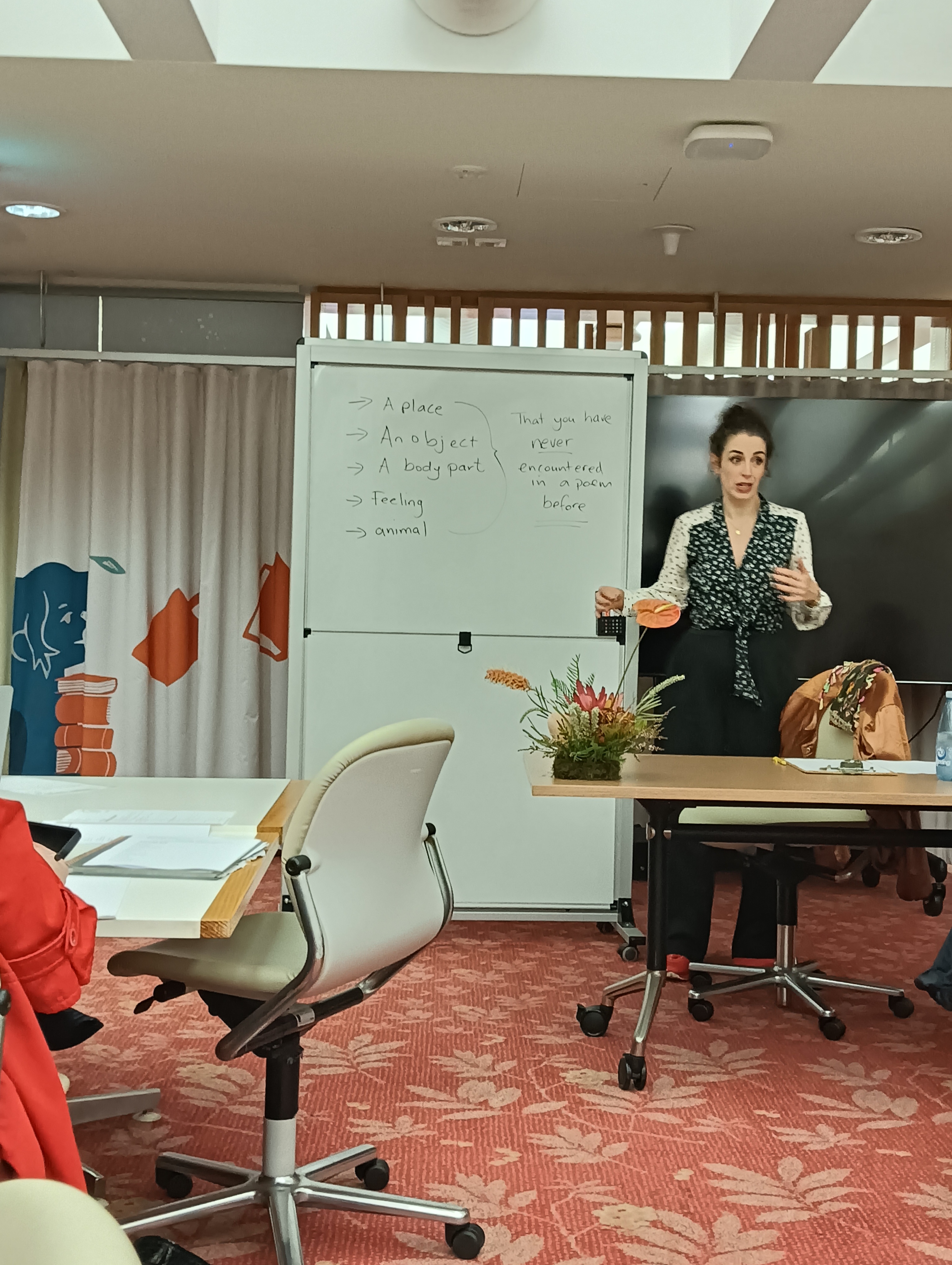
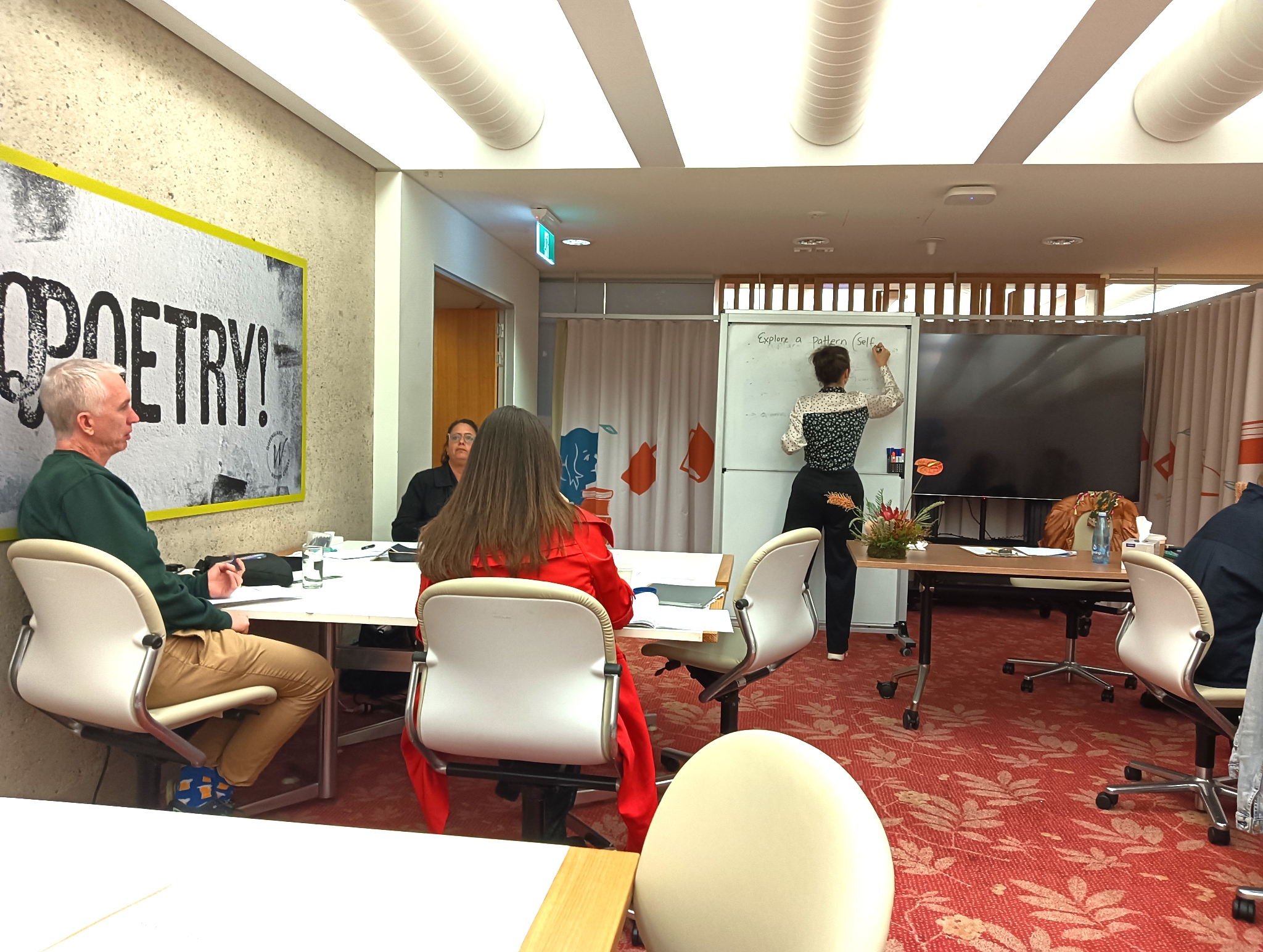
Victoria utilising the white board, poetry hand outs and group and small exercises. August 9th Workshop.
Often within such settings other participants might share their works, although a compassionate workshop presenter never, compels people to share but obviously is happy when they do and able to give feedback, and will set up the safety of the group to make it comfortable for them to share if they should so wish. This might be done through small groups as well as by constructively given critique.
However, what I am keen to share the way in which Victoria generally structured her sessions and the supportive tone she set for us to take risks. As well as her qualities as a facilitator as they will inspire you as a teacher or facilitator as to how to draw works from your creative mentees, in this case adult learners whom she had never met before, in another country.
In each session Victoria ran 4-5 creative exercises with us. Sometimes after some source inspiration, she gave us opportunities for timed short creative writes of 7 minutes. She gave us time to small group share within a pair or a group of three. She harnessed some powerful Irish poets through sharing samples of their work. They were a mix of male, female, working class, middle class – who reflected different styles, and utilised those texts as mentor texts to discuss and model and inspire our writing.
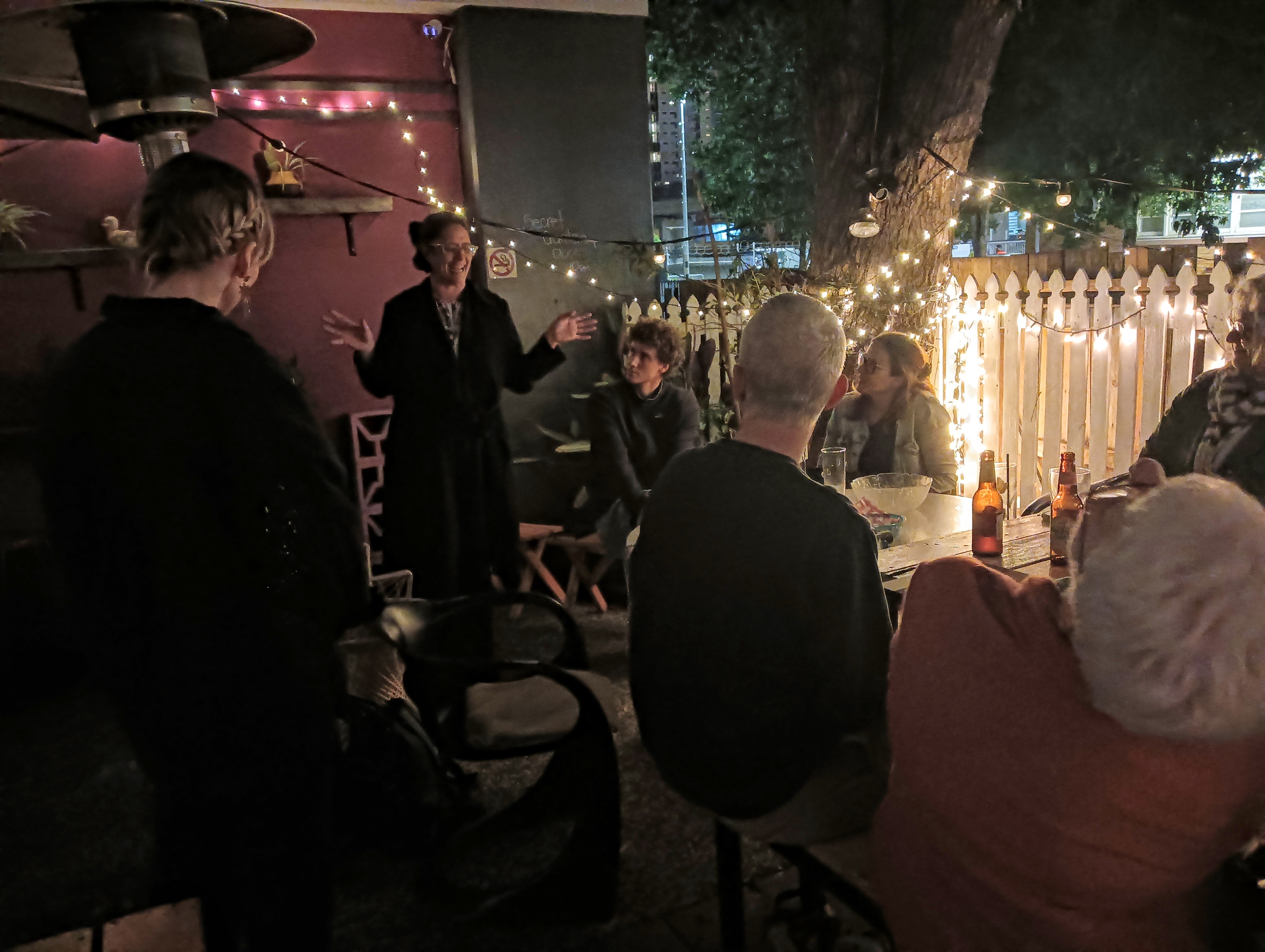
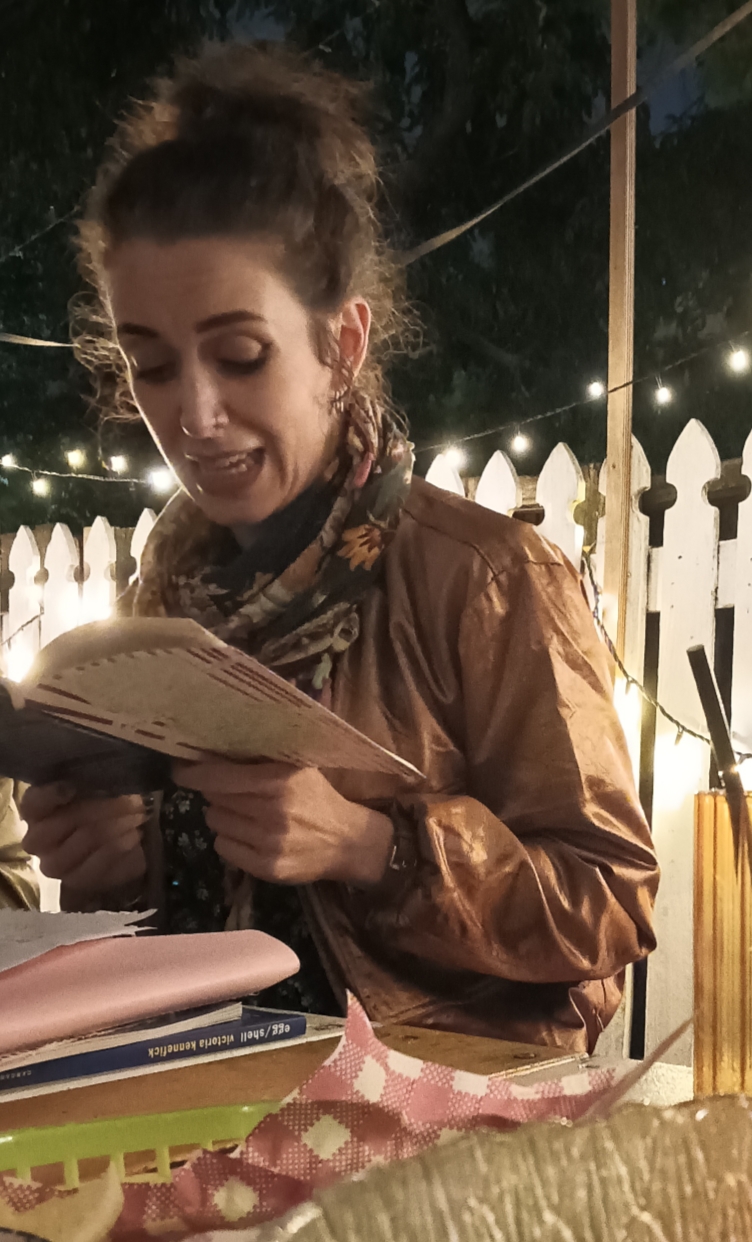
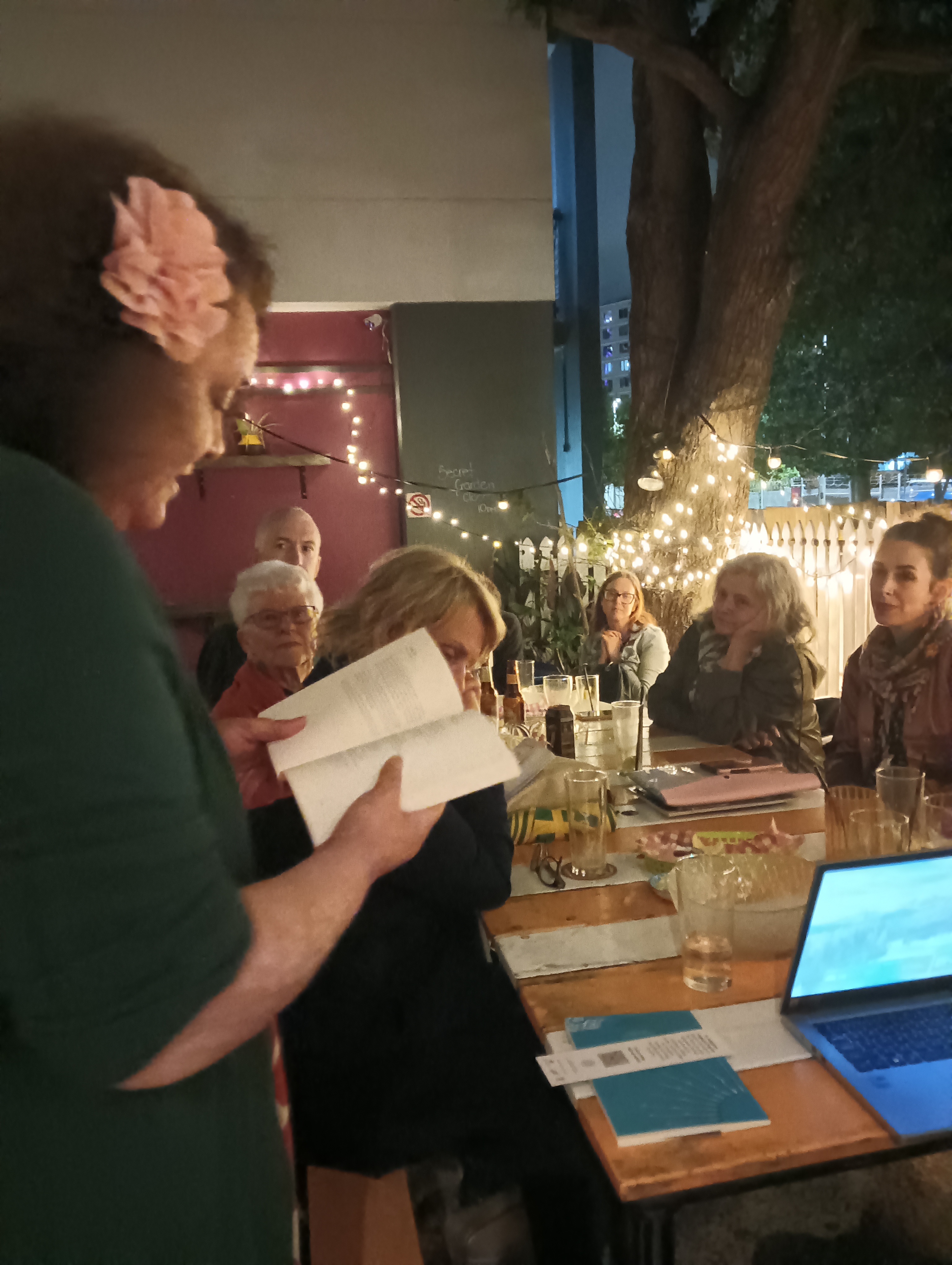
We heard her read at the Open mikes (there were no microphones though, just attentive readers) only after all of us had read (these were held shortly after the workshops, with many of us choosing to go, although some couldn’t make these) and some of us at a Quills and Passionate member Soiree event.
Open Readings, held after the workshops
In our quick creative write responses, she asked us to put our editorial voice, or our critics voice to one side, and just write whatever came to us, if possible scarcely lifting our pens off paper and not worrying about punctuation or anything. We could laptop it or handwrite.
She gave us highly interesting prompts which were often reading poets and reflecting on their work, in discussion and turning to actions like thinking of potentials of things that don’t have many poems about them or something that frustrated us – that cause tension with others. I’ve made note of these and can come back to them in the future. She encouraged us to be brave, creative, and dig deeply if we wanted to.
Sometimes she invited us to read a work, taking two to three contributions from the larger group, listening, and providing feedback, before moving to the next exercise. Sometimes she invited someone else to read one of the mentoring poem examples, and sometimes she read these. Never compelling anyone to do so, but always inviting. She used phrases such as ‘tread as heavily or gently as you need to’ in our free write topics, and gave trigger warnings on some of the poems as well.
Some of the participants preparing for their next creative exercise with Victoria.
She expanded our vision, by introducing poets we may not have known of. In the second session, she began to do some editing and shaping, making suggestions for some things we might do, and she also invited us to be inspired by particular words and phrases in the poetry we were reading.
I truly appreciated this sensitive and interactive approach, and the results it was pulling out of me. I was very taken with the beginnings of three of my pieces, and went home and developed them between and after sessions. For those of us who made the first session, we shared something we had worked on during the week, and our peers gave us feedback. Others could share something they had composed in the new session.
Again Victoria modelled as well as asked us to be constructive in our feedback. We focused on lines we particularly liked, or something that might have stood out to us in the style.
Thanks to the Queensland Writers Centre, Arts Queensland and anyone responsible for bringing Victoria out here to encourage local poets, especially Victoria for enduring a long plane ride to make it here.
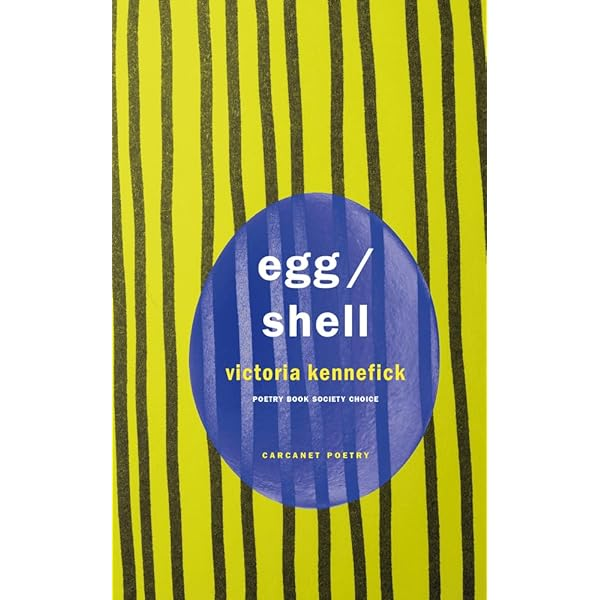
You can purchase Victoria’s collections online at Carcanet Press
More about the magic of open mikes in my next post.
As for what the monsters are on my back they might appear in my next collections of poems.
A major highlight of the last few months was attending a Master poetry class/workshop with the immensely talented Mindy Gill at the Queensland Writer’s Centre.
About Mindy
Mindy's work has been recognised both nationally and internationally, by awards and fellowships such as the Queensland Premier's Young Writers and Publishers Award, the RMIT Visiting Poets Program, the CMI Arts Initiative in Chennai, and the Australian Poetry/NAHR Eco-Poetry Fellowship in Val Taleggio, Italy, amongst others. In 2021, Mindy was named Australian Book Review's fifth Rising Star.

Mindy's poetry and criticism have appeared in Award Winning Australian Writing, Australian Book Review, Sydney Review of Books, Griffith Review, Island Magazine, Australian Poetry Journal, Hecate, Cordite, Stilts, Rabbit Poetry Journal, Mascara Literary Review, Meanjin Plumwood Mountain, StylusLit, The Lifted Brow, The Penguin Book of Indian Poets, the Institute of Modern Art and the Queensland Art Gallery. From 2017-2020, Mindy was Peril Magazine's Editor-in-Chief.
This intensive session focusing on one poem of each of the three participating poets, was a brilliant experience.
I am applying workshop learnings to elevate not only the one we looked at, but some of my other poems, working from my strengths and to expand brimming ideas into extended poetic narrative. All fellow poets, Alexander McCallum, Mindy Gill, and Joanna Ward were inspiring.
Anthology
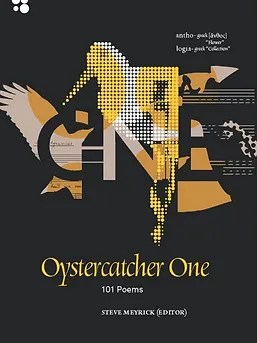
It was a thrill to make it into Oystercatcher One, edited by Steve Meyrick, in a new press inspired by Ron Pretty and continuing his legacy. This launches in a couple of weeks and preorders are available.
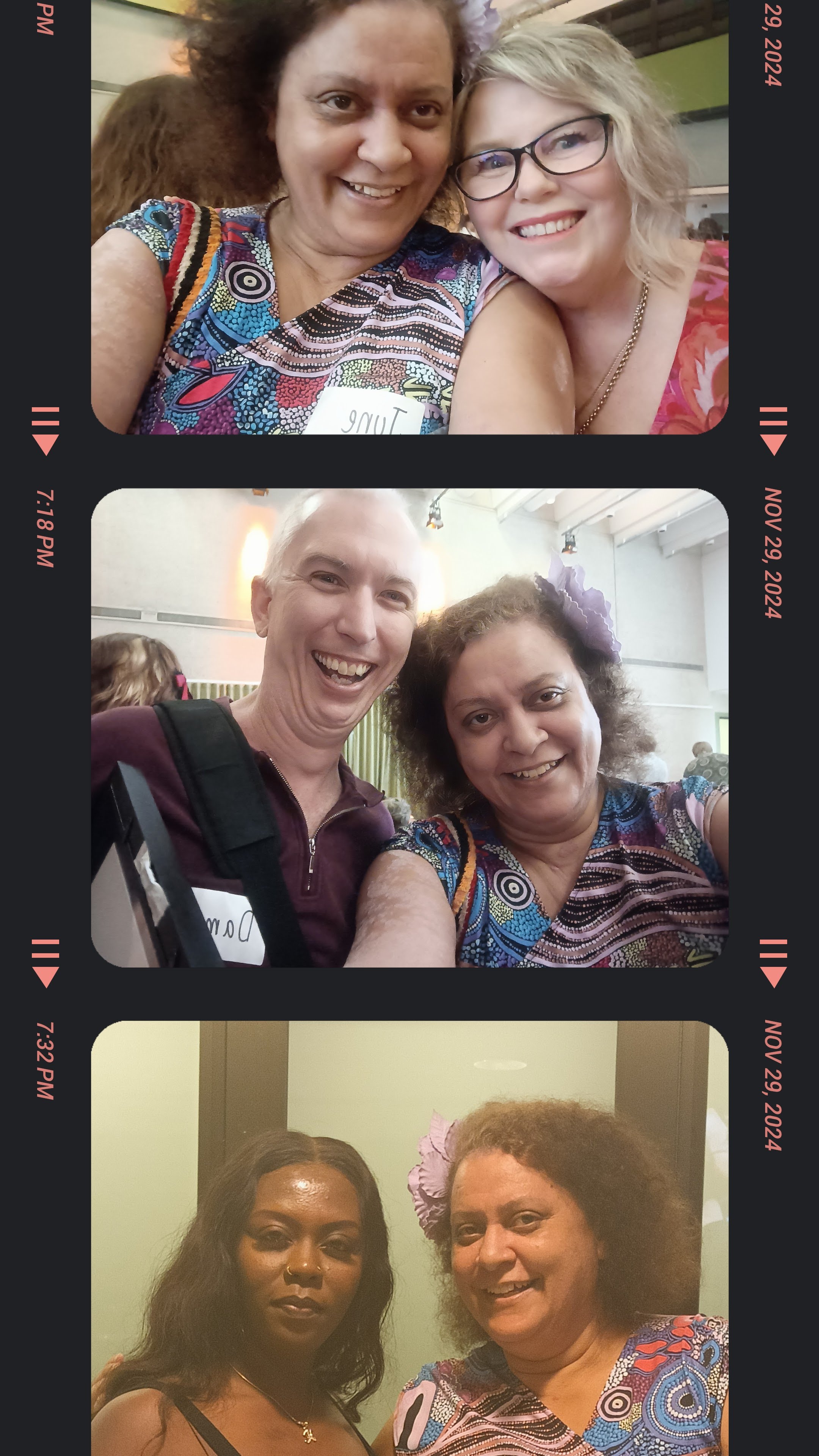
With Jacque Duffy (Johnno nominee), Damen O’Brien(Val Vallis award) and Huda (poetry mentor and performer)
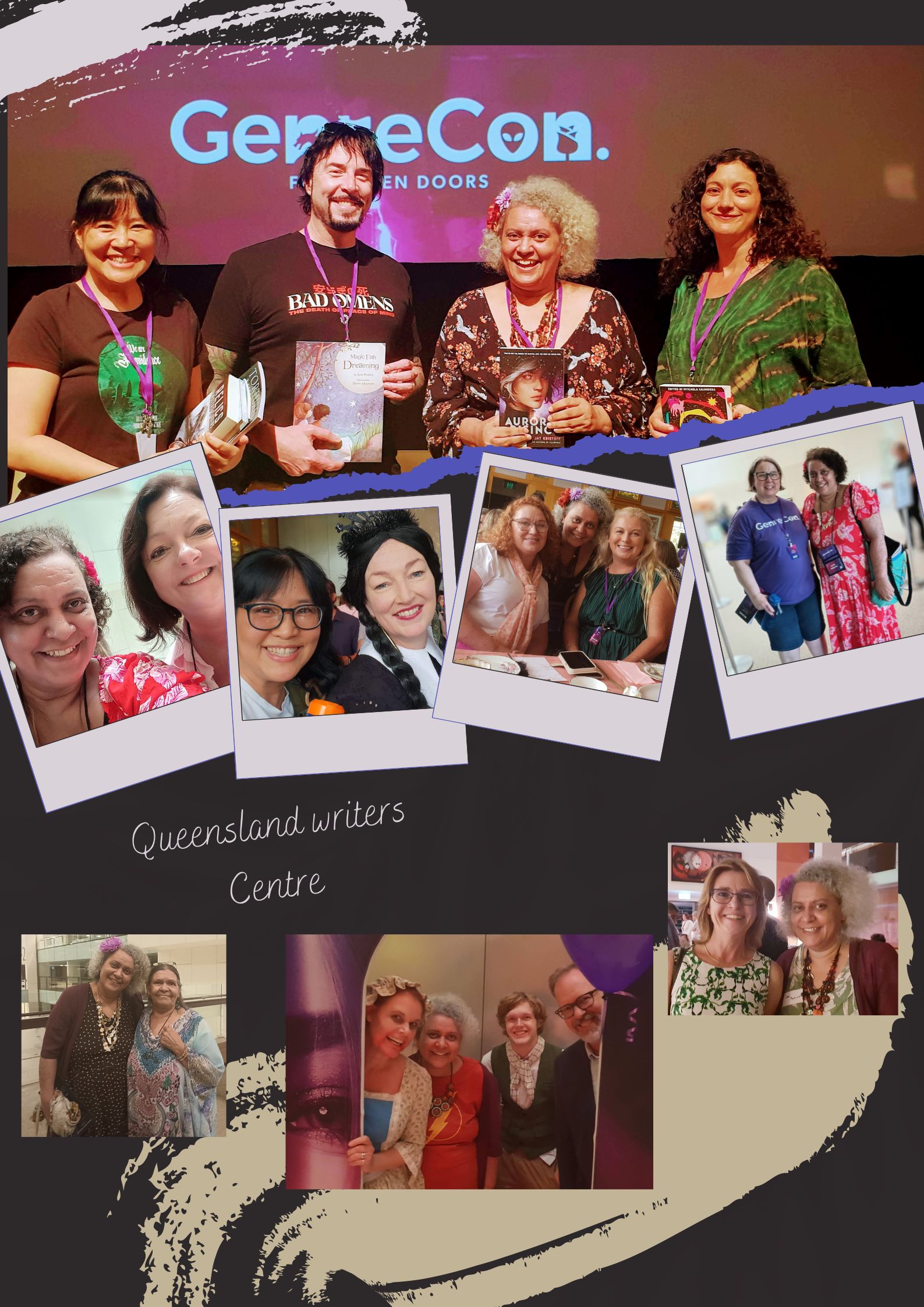
The Queensland Writers Centre, Christmas Party, Johnno Award and now also a poetry award night, was mega.
LJ likes to rally writing tribes, and create and celebrate team spirit going into each summer break and this year was no exception, and featured a deconstructed thread that metaphorically turned gold as the night continued.
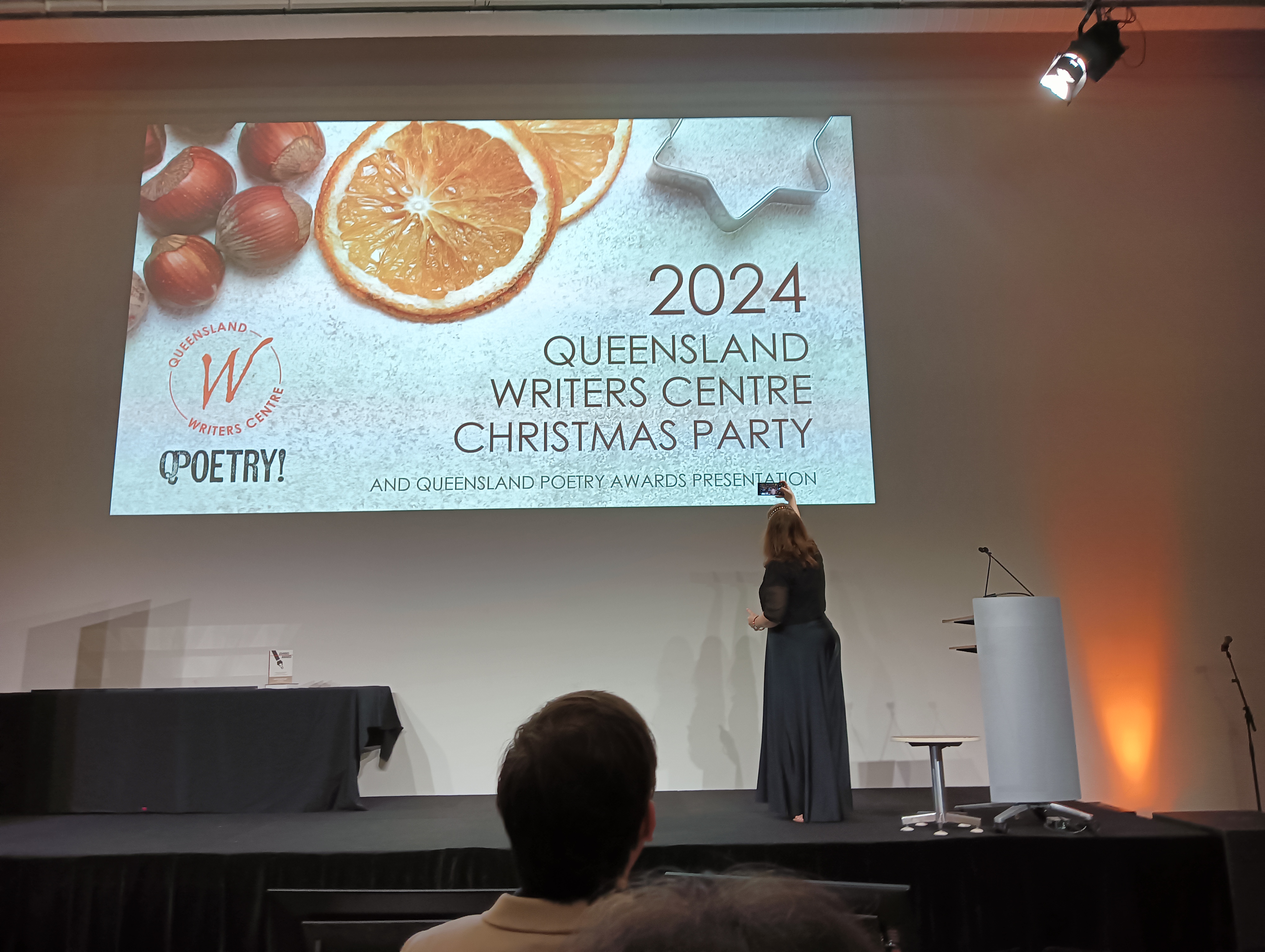
This year also saw the life bucket moment of current Chair Jemma Polari, taking her on stage selfie with all attending included.
Jemma Polari taking her epic selfie! Visit her on instagram @jemmapolari to see the result
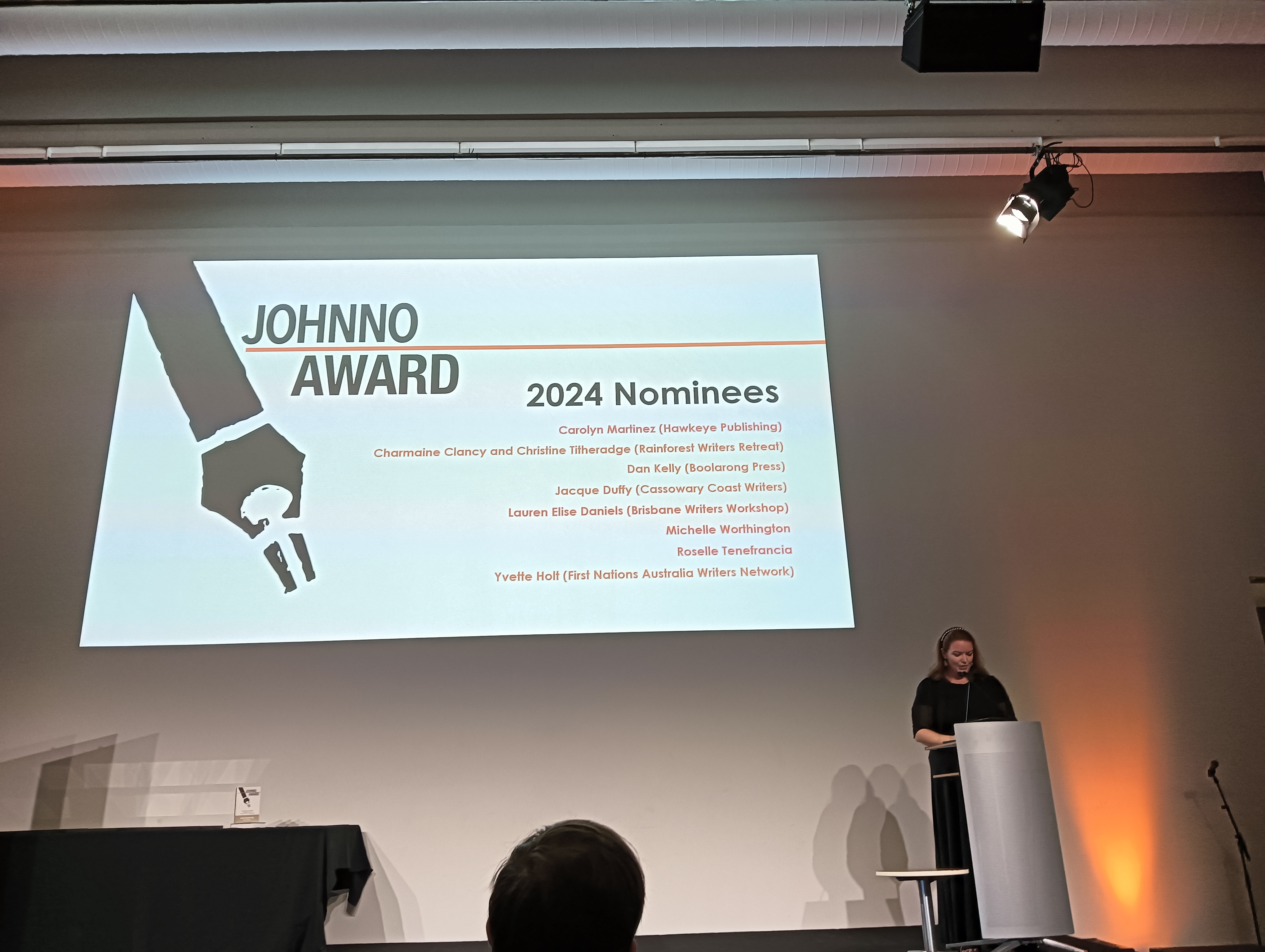
The Johnno Award is one of those ones were everyone nominated feels humbled to be included. It is focused on service and volunteer work to support writers and writing. It was an honour to know so many of the nominees. What brilliant people they are. So generous with their time to develop other writers.
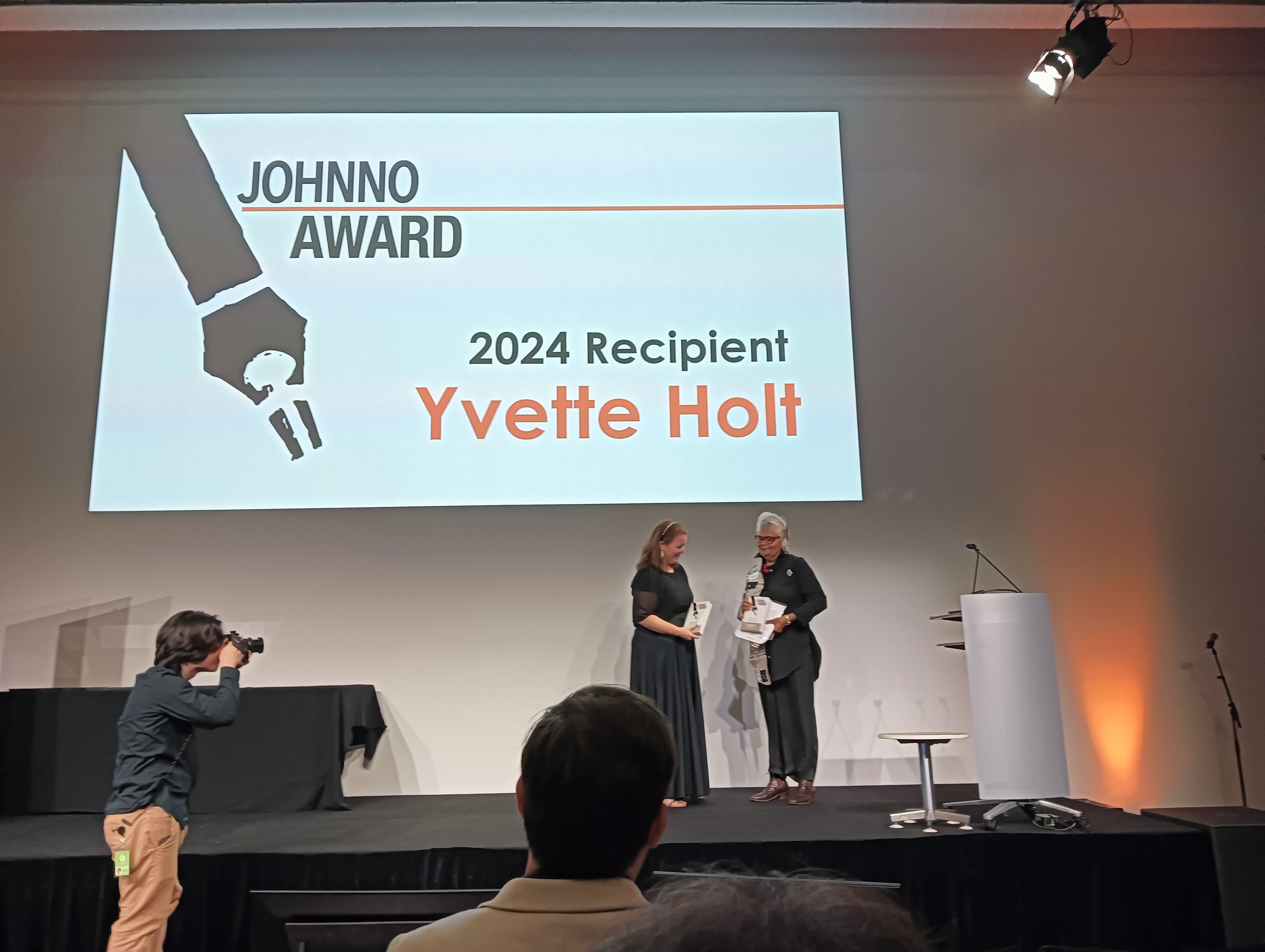
This years Johnno recipient was Yvette Holt from FNAWN, who gave a moving speech, off script, wishing the award was jigsawed between all nominees, all mighty in their areas of contribution. She paid tribute to the Godfather of Queensland Poetry, David Malouf and shared some of her story including early journeys with Debra Dank.
There were poetry awards, ably presented by Jared Bruinstrop, who also emcd the whole evening. One of the most notable moments of this was Huda the Godesses’s powerful spoken word set conveying and lifting the voice of women, recognising artists and her grandmother, mother and aunties. And Damen O’Brien, opting not to give a speech but simply smile brilliantly and move off that stage.
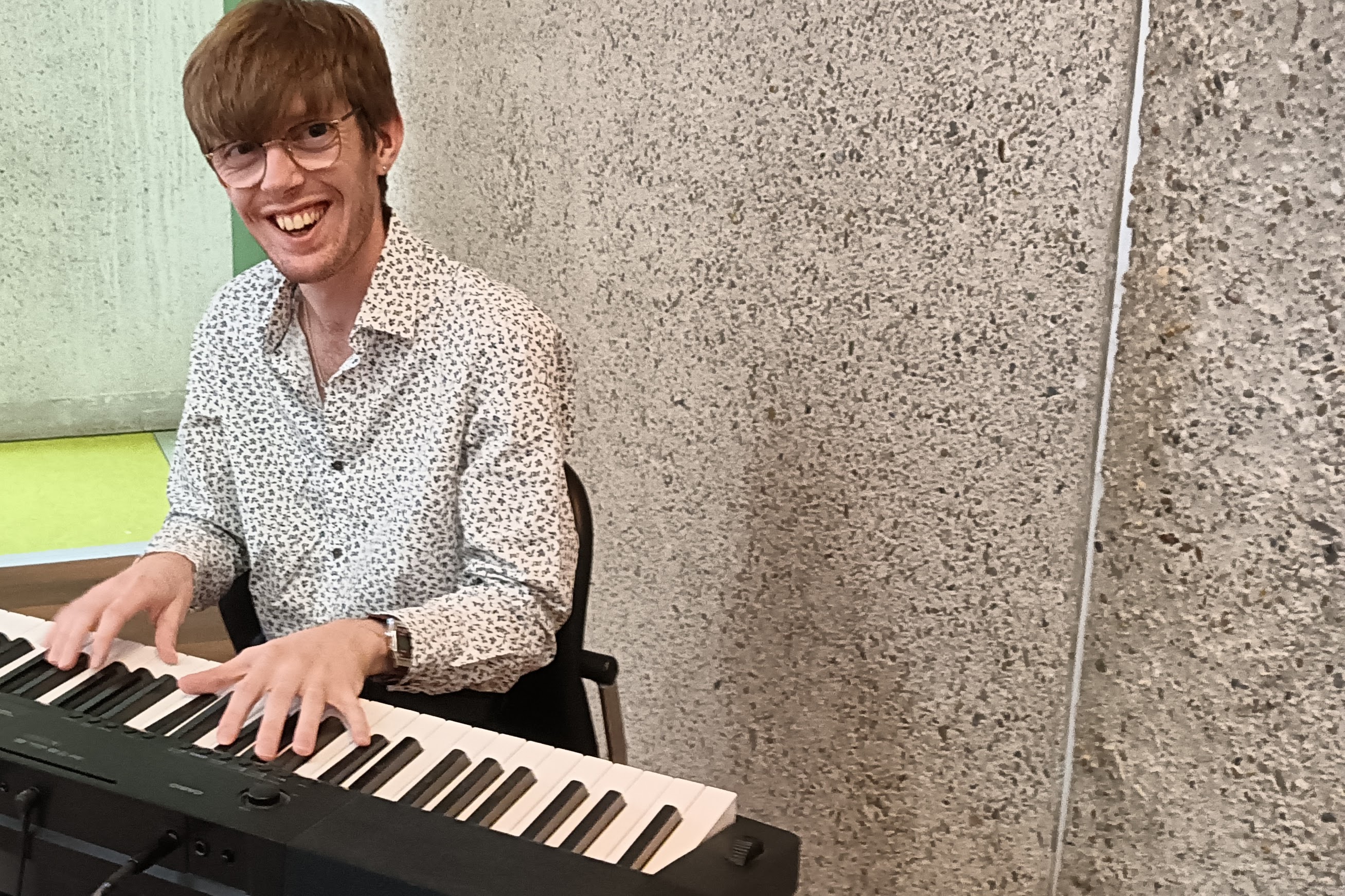
And what is a Christmas party for the QLD writers centre without Charlie’s atmospheric piano, this years electronic keyboard sounding great.
Charlie
Another four wonderful things were: learning more about the history of the poetry awards, from UQ Press; finding an old Far North Queensland friend (nominated for Johnno) Jacque Duffy in the audience; catching up with friends made at QPoetry; and the slide show of the year’s writing activities on a big screen!
I saw many fabulous kidslit buddies, storytellers, and had a few fascinating, but all too brief conversations, as is the case at such events where there are so many people to catch up with. Thank you for the warm hugs from several of the management committee members who I served alongside with for a couple of years. Great to see you all doing so well!
Thanks to all those who did chat, especially those who sought me out to do so, when I was having a quiet sit down after a long week!
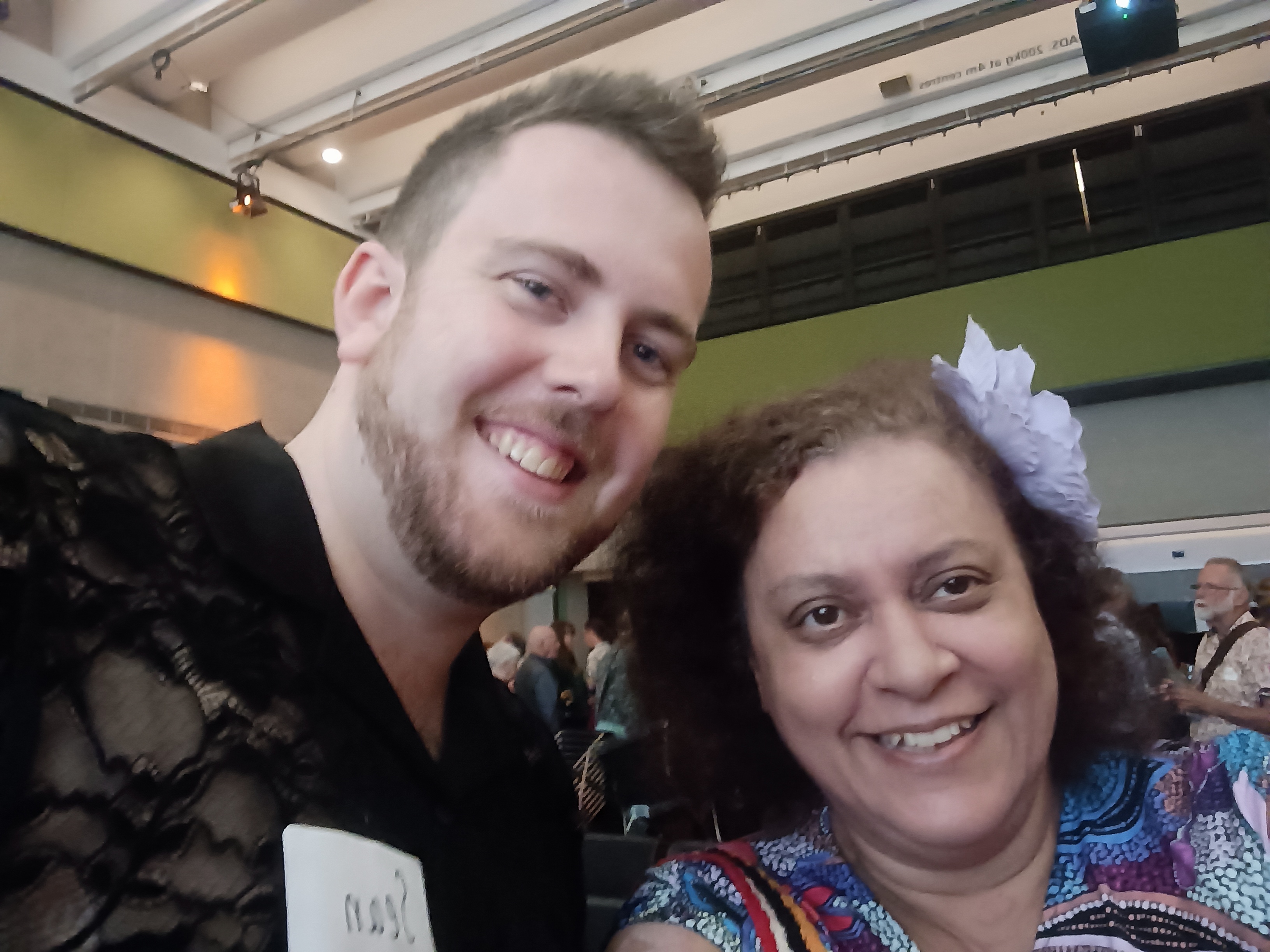
With Charmaine Clancy, nominee for JohnnoWith Runner up Thomas Shapcott, Unpublished Manuscript – Only Guesswork – Sean West – Glitterbish
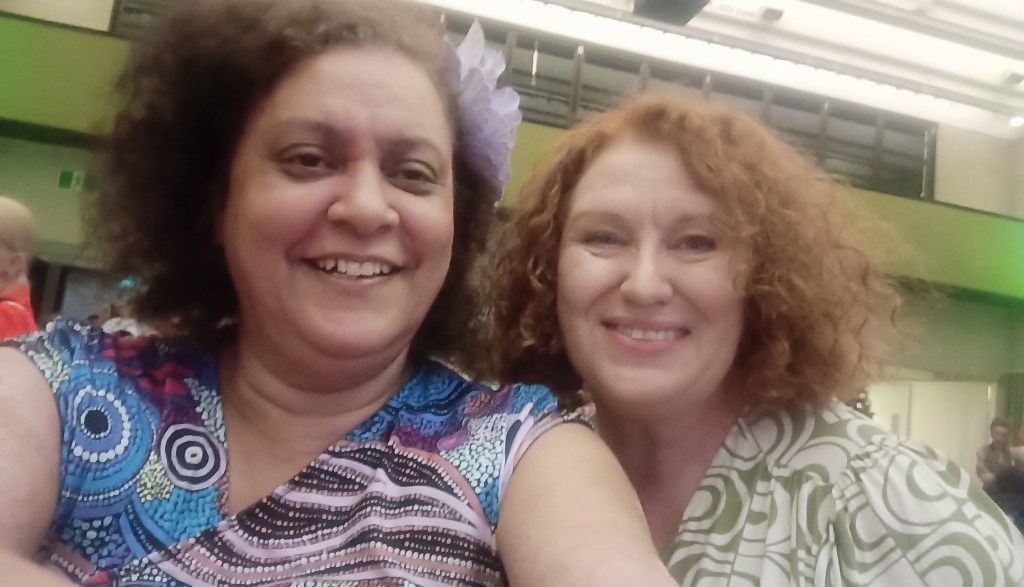
I’ll add the photograph of me and LJ to this post soon. It was lovely LJ nabbed me on the way in to organise a picture. She is so sweet to former Chairs and remembers our service with gratitude and warmth. Was also lovely to meet the Oodgeroo Poetry award winner, Nathan Sentance and his partner.
Amazing to be part of the Quills.
Many thanks to the Writers Centre, poets, kids lit, Genre Con, staff, volunteers, all other creatives, readers, Arts Queensland and of course our families, and new and emerging writers. Love you all, you are my writing tribe.
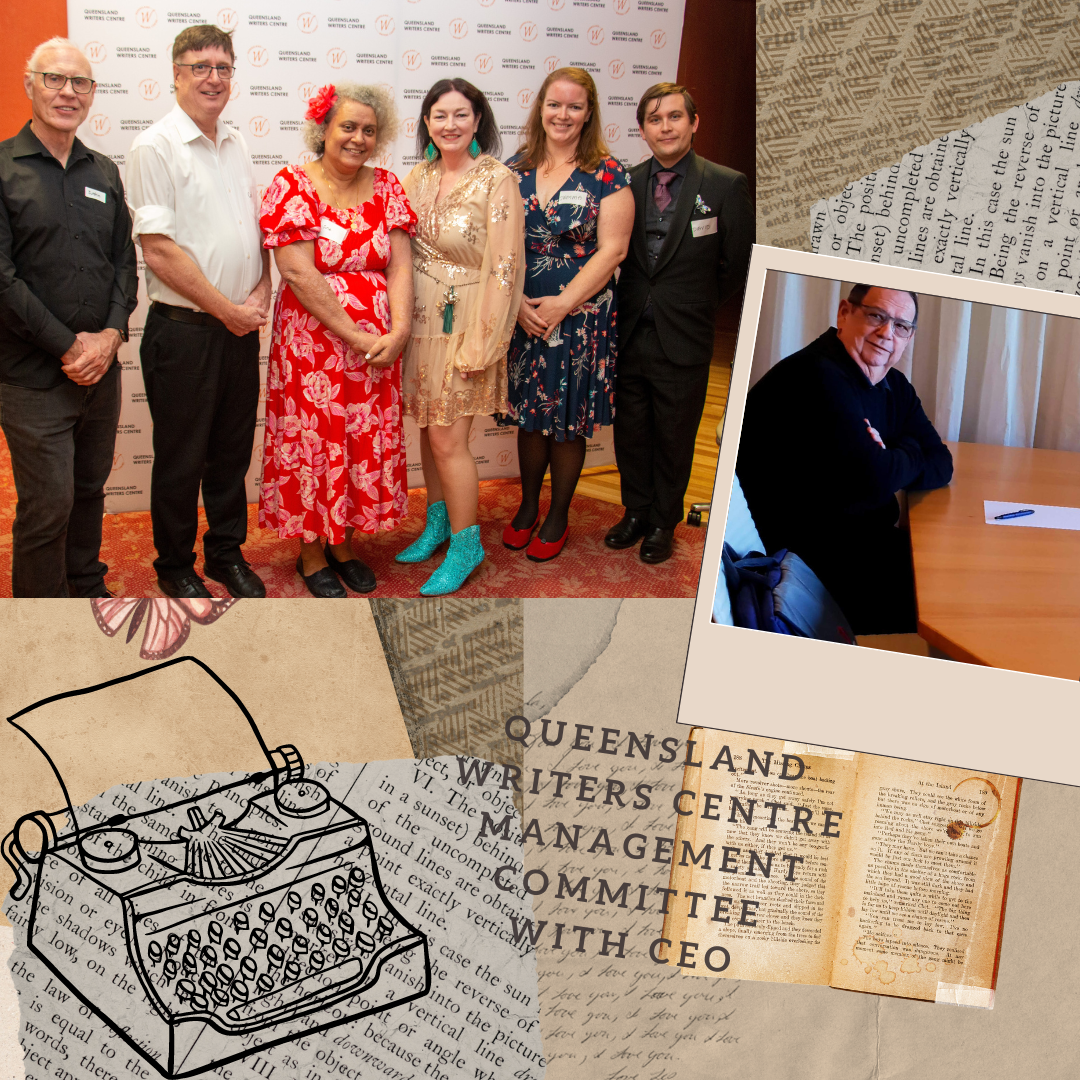
It has been a tremendous two years serving on the Queensland Writer’s Centre Management Committee as Chair alongside other dedicated members, especially, Jemma, Mary, Justin, Lara, Stephen, David, Peter and Colin.
I will continue to be a ‘critical friend’ to the Diversity and Inclusion subcommittee, but am excited for the next chapter, stepping away to finish my masters of teaching and work on my writing projects.
Many thanks to all the staff, especially CEO Lori-Jay Ellis, Sandra Makaresz and Charlie Hester, volunteers, interns and subcommittee members for all that you do for the Queensland Writers Centre.
Selected highlights of service and connection on the Queensland Writers Centre Management Committee
Nene Cohen, Pamela Jeffs, Geneve Flynn, Lauren Elise Daniels, & finding out about legal deposit from National Library Canberra, delegate attending.
The titles of many of the sessions for Genre-Con this year were very enticing.
For instance Whales, Rivers and Serpents Australian Crime, Meet Me in the Grey Area: From YA to NA to Adult, Campfires, Cobwebs and Corpses,and Getting Graphic with Graphic Novels.
So yes that did successfully make me excited about the above sessions, but sometimes there were a few I would have loved to make it to, but there was an equally attractive session at the same time. Argh. This is when it is handy to have a friend make that session and swap notes!
This is an excellent challenge to have at a conference!
But what genre do you write June? You might ask. Well I am willing to try and combine many genres. I find that some of my stories are fantastical tales, for Young Adults (YA), to adult, and I love reading and watching crime, not sure about writing it, but I find the genre super interesting because I read and watch so much of it. I am working on a poetry novel that could end up being YA. YA encompasses many genres.
In Brisbane, some of the loveliest writers you can meet, are the Horror and Speculative Fiction writers. I’ve been reading some of their works since the last conference, and love the folk tale, culturally influenced horror, what is scary with a deep message.
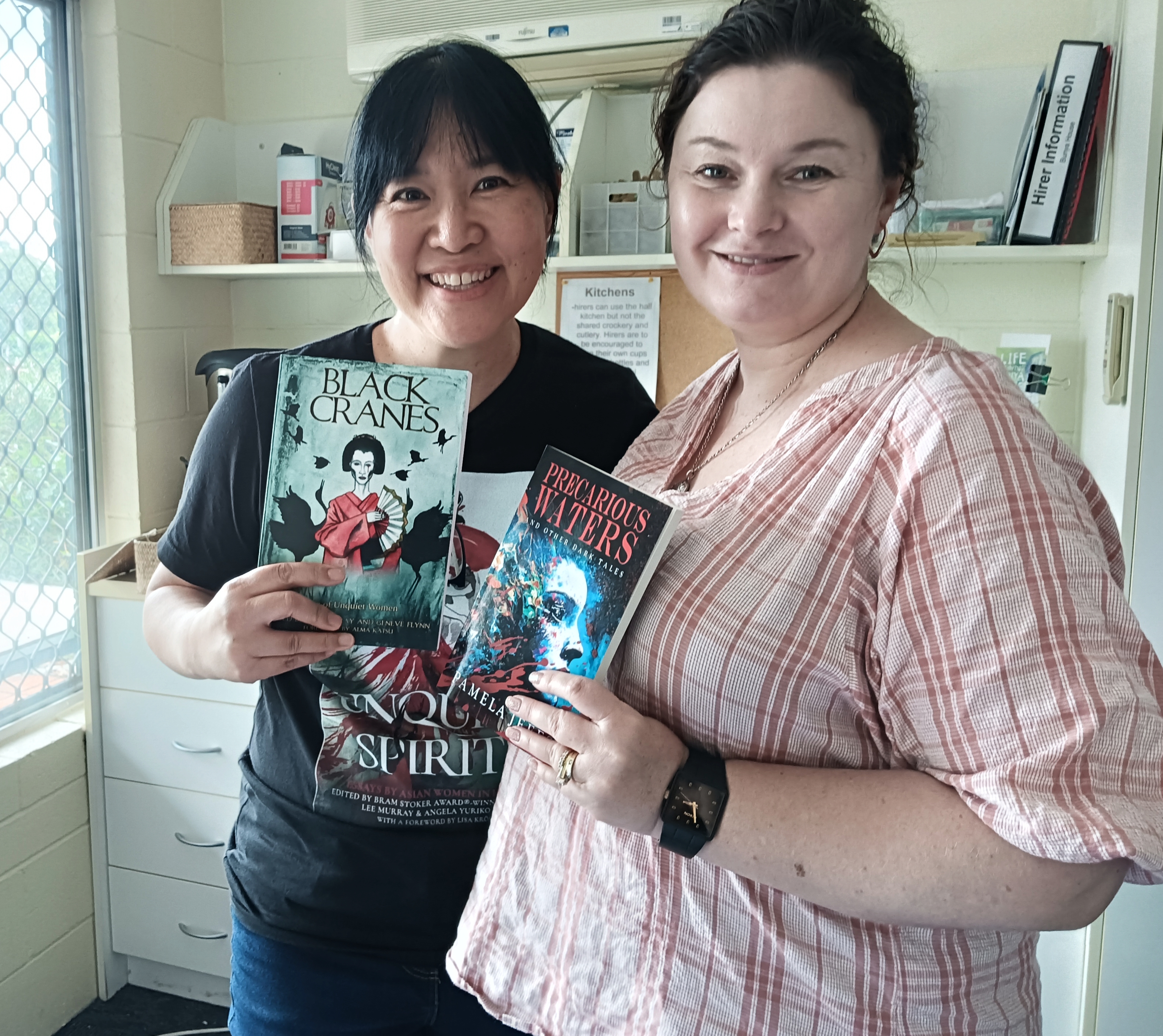
Geneve Flynn and Pamela Jeffs, at Author Gala Event, March 17th Bunya House: photography June Perkins
I recently did some storytelling, and realised I am attracted to rewriting fairy tales and folktales, to challenging norms, and ideas. I’ve also been working on my Grandmother’s stories as passed on from my Mum and considering what can and should be kept the same, and what could be adapted to a diaspora granddaughter’s experience of today.
Okay so here is a run down of one session I particularly enjoyed.
Who knows maybe one day I will come up with crime fiction, although mine may well be a cozy mystery.
Whales, Rivers and Serpents Australian Crime
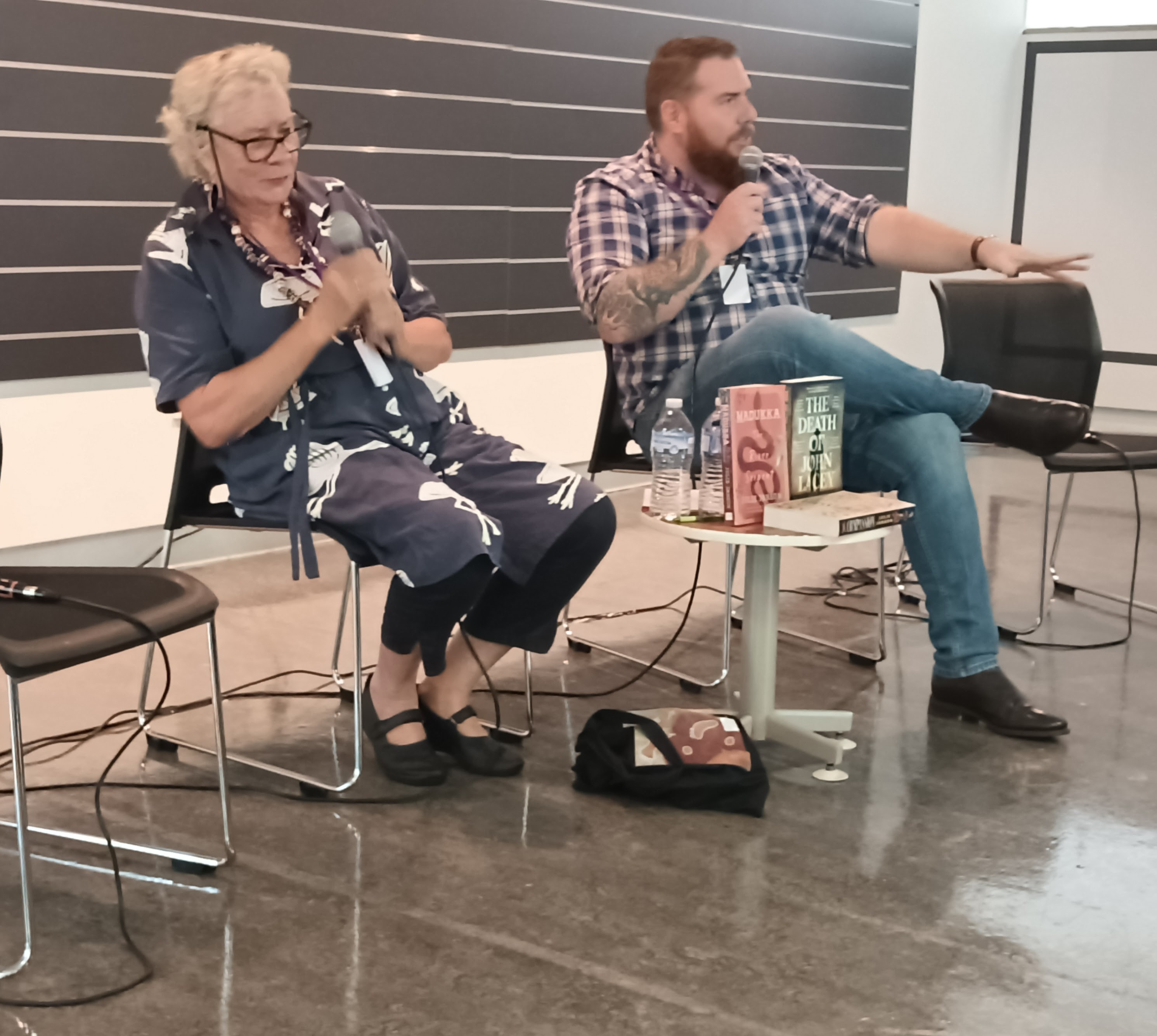
Julie Janson and Ben Hobson, Genre Con, State Library February, 2024
Julie Janson and Ben Hobson ran their session like a podcast, interview format. This was quite relaxed, organic whilst being informative.
They outlined that both of them had taken ten years to publish their first crime novels. Both come from a teaching background, and Ben is still in the teaching.
Julie’s background is drama. And she began writing plays to assist with and motivate literacy in the communities she worked in. One of her favourite crime shows is Vera.
Ben’s work is an examination of what might happen to a person if they are backed into a corner. What are people capable of when something is really challenging?
Julie likes to put a character into jeopardy and seeks inspiration from Aunties, Sisters, actors like the late Lillian Crombie.
Ben likes to inhabit characters and improvise them rather than completely pre-plan.
Julie describes a process where scenes from real life can be inspiration for moments in life. She tells us an anecdote of a bikie, describes him as imposing, his request being camomile tea in the kitchen. Her planning process is to follow the shape of drama, beginning, middle, end, and climax points. ‘To write interesting crime fiction, live an interesting life, makes for an interesting book, knowing about several places. Using terrible experiences gives authenticity to writing.’ Julie quotes Graham Greene ‘Every Writer has a slither of Ice in their Heart’ where they are capable of transforming anything for the sake of art, from their world and people around them.
Ben like’s using the ‘uncanny valley’, outback noire.
(ASIDE: Would you believe this is the first time I have ever heard of the uncanny valley’? Obviously I have not written much crime or scary stuff before. )
“The uncanny valley phenomenon can be described as an eerie or unsettling feeling that some people experience in response to the not-quite-human”
Julie crime fiction is a genre of truth-telling and suited to First Nations authors and explorations of crime and history. Historical crimes you have to stick to the facts. Different kinds of truth can be examined in crime fiction.
Somebody from the audience asked if writing crime kept either author up at night. Both answered no.
Julie even said in fiction you can change the outcomes and give more agency to your characters, to have more power than they may have in reality.
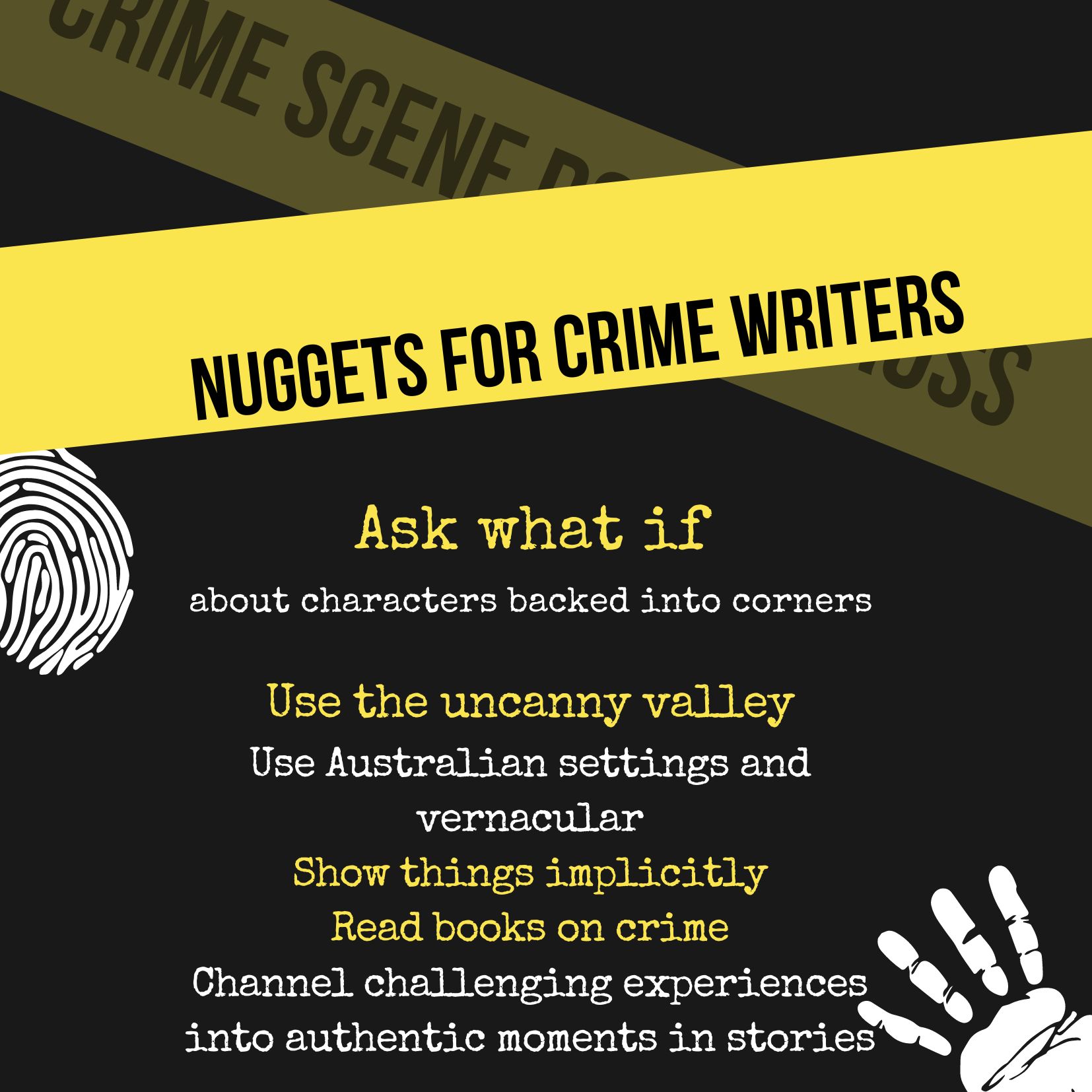
A summary of the workshop nuggets, created in Canva by June Perkins







 June Paisa Perkins